
Showing posts with label preps. Show all posts
Showing posts with label preps. Show all posts
1/26/13
Cabin Fever
Last year, Dave Canterbury spent a good portion of the winter in a yurt. This time around, looks like he's upgrading to a small cabin. The above video shows the initial tour of the place and runs through some of the features of the cabin. It's not big - single room with a loft, with enough room for some beds, table, gun rack and wood stove.
Dave runs through the cost for the cabin - $4.6k for the cabin kit, plus an estimated $4k for the stuff on the interior - wood stove, furnishings, etc. Though $4k does seem a bit high for the furnishings shown...probably all of the interior wood had to be purchased as well. Plus several days to assemble. So around $9K, more or less, plus a few days of work. That's not bad. You could certainly do it for less without the cabin kit and using/processing raw materials from your land.
Long term, my plan is to buy a plot of land up in the mountains somewhere and build a mostly off-the-grid cabin. It probably would not be a full time residence, at least not initially. If there's an existing cabin that fits the needs and budget, then that's great, but I may end up getting raw land and then building something down the road, so Dave's little cabin got the gears churning.
Dave's cabin is probably a bit small for what I'd like for long term living. A little more elbow room and a basic bathroom would be nice - composting toilet, probably. I'd build the cabin over a root cellar/basement for added storage. Plenty of space for stored food. And a cellar would be easier to fortify for secure storage when we weren't on-site.
A well, pump, water catchment system and cistern would handle the water needs; a spring, stream, etc. on the land would be a good backup. A basic solar or windmill system for lighting, a 12V fridge, comms and some perimeter security stuff. Eventually, we'd add some buried fuels tanks.
Down the road, as the family grows older and expands, we'd probably build an additional cabin or two to allow family and friends to have their own space. An outbuilding for tools and toys. At some point, we'd move to the land full time, and then probably add a hen house and maybe a small barn.
Anyways, nothing too fancy - cozy, simple and functional. A ways down the road, but always interesting to see what others are doing, learn and plan.


8/12/12
Hill People Gear Mountain Serape
 |
| The HPG Mountain Serape in poncho mode. And no, the Serape does not provide a black vortex of identity concealment - that's just Photoshop. |
What's the big deal? The Mountain Serape does a solid job of serving multiple roles--it's not just a blanket--it switches from poncho to great coat to blanket to sleeping bag. It's no gimmick, either--the design is well thought out and transitions easily into different modes.
The Serape is one of my favorite pieces of gear that I've bought in a long while. In the time I've had with it, the Serape has become one of my go-to pieces of kit, whether for travelling, hiking or camping. It's mountain man meets modern materials and smart design--a great piece of multipurpose kit, well suited for the back country or hunkering down in a more urban environment.
The Serape has been out of stock at HPG for several months while they've relocated production to the States, but I was lucky enough to snag one of the last generation in the spring. HPG is just getting the new, made in the U.S.A. model in stock, and so I thought it was about time to give the heads up.
Full review and pictures after the jump!
2/28/12
The Venerable Bandolier
 |
| A four pocket 5.56mm bandolier and safety pinned charger |
A bandolier packages what would otherwise be loose ammunition into a mobile package, allowing a fighter to replenish emptied magazines quickly. Unlike loaded magazines, bandoliers work well for deep storage--there are no springs to worry about. They're also fairly inexpensive, though the price has gone up in recent years; current "repack kit" prices run around $6 to $10, depending on the source.
2/23/12
THRIVE Broccoli & Cheese Soup Mix
 |
| Watch out, Pioneer Woman! |
This easy-to-use soup mix from our friends at Shelf Reliance is entirely different. It blows other soup mixes that I've had out of the water. It goes way beyond being palatable--it's actually pretty darn good.

2/22/12
The Value of Books Post-Collapse
In the comet/apocalypse classic Lucifer's Hammer, one of the survivors takes the effort to cache hundreds of books--individually sealed and then buried an a cleared out septic tank. They're books on a wide range of topics--science, industry, history--with the intent that they could be used to one day rebuild civilization.
No survivor should be without a library of useful books, be they military manuals and survival guides, technical manuals, religious texts, histories or more theoretical. They can teach useful skills and knowledge pre-collapse, and help with survival and rebuilding efforts if/when the collapse comes.
In this day and age of easily available internet info and digital readers, physical printed books are often overlooked. Unfortunately, in a collapse scenario, this information would quickly become unavailable. Good luck getting those how-to's on YouTube when the grid is down.
No survivor should be without a library of useful books, be they military manuals and survival guides, technical manuals, religious texts, histories or more theoretical. They can teach useful skills and knowledge pre-collapse, and help with survival and rebuilding efforts if/when the collapse comes.
In this day and age of easily available internet info and digital readers, physical printed books are often overlooked. Unfortunately, in a collapse scenario, this information would quickly become unavailable. Good luck getting those how-to's on YouTube when the grid is down.
2/1/12
DIY Survival Candles
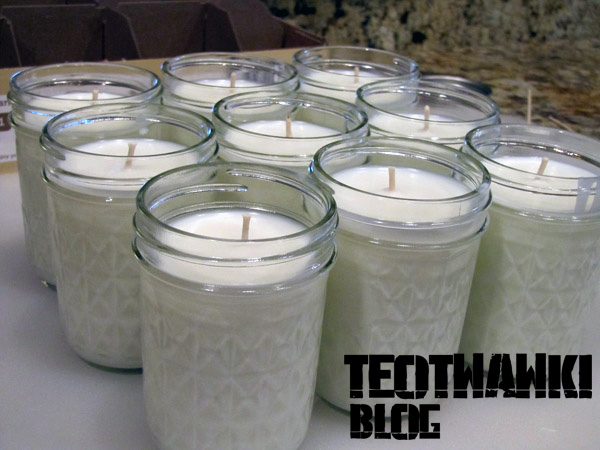
Candles are an easy-to-use source of emergency lighting and a little bit of heat. I'm shocked to see some of the prices that are charged for long burning candles sold for survival or emergency preparedness - if you want to buy a dozen or so candles, the cost really starts to add up.
Never fear! You can make your own survival candles at home for cheap, using high-quality, long burning soy wax. It's an easy project - the materials are easy to buy and you won't need any specialized tools.
1/29/12
Doomsday #Preppers - Season 2 Sneak Peek

The concept of Doomsday Preppers is pretty cool - a "prepper" shows you what they've done to get ready for a particular disaster, and then an unnamed panel of survival experts evaluates their preps and makes recommendations. It's fairly well done and unbiased - there's no attempt to portray the preppers as crazies, though some of the preppers are certainly a little bit more, err, eccentric than others. The expert recommendations are usually pretty spot-on, too.
National Geographic reached out to me last week to see if I would be interested in an advanced screener copy of the first episode of Season 2. I guess we've hit the big time here at T-Blog! Hard to say no to a sneak peak - the DVD was at my door on Friday.
1/13/12
Weekend Open Thread - What are your prepping goals for the year?
Last year was the first year that I actually sat down and wrote down my prepping goals for the year, and I found it to be massively beneficial in guiding my efforts. This year, I'm planning on making it an official, sit-down thing with TEOTWAWKI Wife. We've been in a sort of graduate-school limbo for the past several years, and I will be done and working full time by mid-year, so we should be able to make some major strides.
Anyways, in order to help motivate you guys, I thought I'd run an open thread. What are your prepping goals for 2012?
Remember, good goals follow the SMART acronym:
Post up your prepping goals for 2012 in the comments section.
Anyways, in order to help motivate you guys, I thought I'd run an open thread. What are your prepping goals for 2012?
Remember, good goals follow the SMART acronym:
- Specific
- Measurable
- Attainable
- Relevant
- Time based
Post up your prepping goals for 2012 in the comments section.
1/6/12
Don't wait for a disaster
"We started preparing after our area was hit by a bad winter storm."
"Since the stock market tanked, I've invested more heavily in precious metals."
"I've started carrying a bigger handgun since a shooting happened nearby."
I hear these kinds of statements all the time, from good people who needed a wake up call to get them moving in the right direction.
There's certainly something to be said for making adjustments, but at the same time, the problem with these kinds of statements is clear. They're making adjustments after the fact - after disaster has struck.
We are usually fortunate enough to make it through life's problems relatively unscathed, giving us the luxury of after-the-fact analysis. But that's not the point here, really.
We're preparing for something that won't leave us unscathed. Something major and life-altering. Something where there's no second chance and no do-over.
Don't get me wrong--preparedness is a process. You can't wave a magic wand and instantly know everything and have everything that you could ever need to survive any conceivable scenario. We're all working on it.
But DON'T wait around for a disaster to give you a kick in the butt and get you motivated. Don't be lazy about it. Be honest with yourself. Put your skills and your preps to the test before bad times roll around--make the adjustments now, when you can.
I'm preaching to the choir, here, I know. You guys and gals are awake, aware, working and refining. Stay frosty and try to get your friends and family to wake up, too.
"Since the stock market tanked, I've invested more heavily in precious metals."
"I've started carrying a bigger handgun since a shooting happened nearby."
I hear these kinds of statements all the time, from good people who needed a wake up call to get them moving in the right direction.
There's certainly something to be said for making adjustments, but at the same time, the problem with these kinds of statements is clear. They're making adjustments after the fact - after disaster has struck.
We are usually fortunate enough to make it through life's problems relatively unscathed, giving us the luxury of after-the-fact analysis. But that's not the point here, really.
We're preparing for something that won't leave us unscathed. Something major and life-altering. Something where there's no second chance and no do-over.
Don't get me wrong--preparedness is a process. You can't wave a magic wand and instantly know everything and have everything that you could ever need to survive any conceivable scenario. We're all working on it.
But DON'T wait around for a disaster to give you a kick in the butt and get you motivated. Don't be lazy about it. Be honest with yourself. Put your skills and your preps to the test before bad times roll around--make the adjustments now, when you can.
I'm preaching to the choir, here, I know. You guys and gals are awake, aware, working and refining. Stay frosty and try to get your friends and family to wake up, too.
11/22/11
Entertainment after TEOTWAWKI
 |
If you have kids, some forms of entertainment become even more important. Kids can turn most anything into a game/diversion--an empty box will keep 'em occupied for a while--but having something to boost their spirits and keep them occupied during downtime is worth prepping for. Heck, even in an extended power outage, having something to keep the family happy is a huge help.
Board games and card games are an old standby--no power necessary! Many modern families, with video games out the wazoo, don't usually have many on hand. Garage sales are good way to get board games for cheap--we've found unopened games (Risk, Clue) for 50 cents. Generic chess/checkers sets can be had for cheap at big box stores, and a deck of playing cards is only a couple bucks. Point is, you can put together a decent little library of games for not much money.
Good ol' fashioned books--printed on actual paper are another good thing to have around. Garage sales and thrift stores strike again here; Amazon and eBay are good backups for used copies if you're looking for something in particular. I'd recommend some non-TEOTWAWKI books here--if things do get bad, you're going to want a break from the end of the world.
With small source of off-grid power, you can keep technology going after TEOTWAWKI. We have iPhones with games, TV shows, music and movies that distract our son on roadtrips. Eli from Book of Eli had an old school iPod, still going strong decades after the apocalypse. Tablets like the iPad and new Kindle Fire get you a bigger screen that small family could actually watch together, etc. All of these devices can be charged easily via a small-ish solar set up. There are also numerous AA battery powered "backup chargers" on the market for smart phones and iPods--a bulk pack of AAs could keep your device charged for a long while.
If you have a slightly more powerful off-grid power setup, a laptop and a hard drive of movies/DVD collection would be a pretty good thing to have around, too. In both Patriots and Survivors, Rawles' characters have movie nights on Macbook Pros, though he doesn't seem like a Mac guy to me. If you're tight on power supplies, an efficient laptop (long battery life, low power draw) will be what you want. If you're curious, the info written on the power adapter will tell you the laptop's power draw (look for watts and volts).
The classic eInk Amazon Kindles demand a special nod--you can store thousands of books and manuals on them, and the eInk display draws so little power that they can last for two months on a single charge. Pretty good--a lot easier than carrying a big box of books around with you! Amazon has a bunch of classic books available for download for free, too.
All these electronic devices have added advantages (except maybe music-only iPods) in that they can do other work and store other information. Multipurpose and very valuable, if you can keep 'em running.
Anyways, something to give a little thought to. While entertainment is certainly lower priority, it's something that you can easily "check off" the list without too much trouble or expenditure.
7/22/11
Mid-Year Goal Review
Did a mid-year review of some of my goals this past week. Some are coming along, some are done, some are in line to be finished by the end of the year and a couple will need to wait to next year. Goals are a good thing, but if you set 'em and forget 'em, they won't do you much good. I'm guilty of this just as much as everyone else. If you have goals that you set at the beginning of the year, dust 'em off, go over your progress and readjust.
A few of the goals that I can check off:
A few of the goals that I am working on before the end of the year. Nothing monumental, but we work in baby steps 'round here:
A few of the goals that I can check off:
- Be able to sharpen knives to a shaving edge
- Build blow out kits and learn gun shot wound/traumatic injury first aid
- Add a chunk to the emergency fund
- Read at least one book a month (I've decided to cheat and use audiobooks)
A few of the goals that I am working on before the end of the year. Nothing monumental, but we work in baby steps 'round here:
- Add to ammo stores - looking to put back half a case of defensive capable 5.56mm and 9mm
- Add some more mags for the Glock (two regular, one extended) and AR (three)
- Fix up some of my fighting/carry gear a bit
- Rebuild the knife stable (sold off a few knives a bit back). Foolish!
- Lose 20 pounds
- Put some new tires on the family assault vehicle
- Add a couple EDC items - need a dedicated flashlight for my EDC bag, a couple other minor things.
- Want to get some good camping trips in...we haven't been able to get out as much as I'd like this year.
- I want to get in some practice on some 1800s-tech stuff; soap making, candle making, maybe some leather working. Don't have firm plans yet.
Anyways, that's what I've got on my plate. Should be able to pull together more than that. What's on your agendas for the rest of the year, faithful readers?
1/19/11
Inventory Monitoring for Preppers
Part of preparing is building up stockpiles or inventory of various essential goods--food storage, water, ammo and so on. At some point, you will want to start managing your stockpiles and the quantities you have on hand. This is especially important for items that you will be using on a regular basis or rotating--food storage comes to mind here, any other regularly used consumable can get this treatment too--garbage bags, toilet paper, you name it.
Why keep track of your inventory? Well, you have your stockpile to protect against uncertainties, and you want to make sure that you have acceptable quantities on hand at all times, just in case. If TEOTWAWKI hits and you find out, surprise, you've got one roll of TP left, things aren't gong to be pretty. Keeping track of your stockpiles is a smart thing to do.
Here are three different methods to consider:
The P System/Target Quantity
Using this method, you pick a target quantity of inventory to have on hand and then a point where you will re-order. For example, you've got a target of 100 water bottles and you count and purchase more water bottles every two weeks. Say your two weeks goes by and you have 80 water bottles. You go to the store and buy 20, giving you your 100 on hand.
The Q System/Re-Order Point
Using this method, you pick a minimum re-order point; if you hit this number, you will immediately go out and buy more. For example, you've got a 500 round minimum for 9mm; if, at any point, you drop below 500 rounds, you buy more. Usually the re-order size is also fixed (so when you drop below 500 rounds of 9mm, you go out and buy 500 more).
Combination Approach
In this, you combine both the target and re-order point systems. You set a target quantity, time period and also a re-order point. So for example, you have a target of 100 bottles of water, check them every two weeks and have a re-order point of 50. In this system, you replenish your 100 water bottle stockpile every two weeks, but if at any point you drop below 50 water bottles, you go out to the store and get more. This gives you the benefits of both systems--regularly maintaining a target quantity and quick response to low stockpiles. With this method, you'll always have good quantities of critical items on hand.
Weakness: More frequent ordering and more monitoring necessary. However, for most things we're not talking about counting warehouses full of items. Counting canned goods or cases of water bottles is not too difficult or time consuming.
Recommendation and Implementation
The combination approach works best and is recommended for critical survival items and regularly used food stuffs. Discuss target quantities, time periods and re-purchase points with the family; write them down and plan for them. In real life, this could look something like:
Why keep track of your inventory? Well, you have your stockpile to protect against uncertainties, and you want to make sure that you have acceptable quantities on hand at all times, just in case. If TEOTWAWKI hits and you find out, surprise, you've got one roll of TP left, things aren't gong to be pretty. Keeping track of your stockpiles is a smart thing to do.
Here are three different methods to consider:
The P System/Target Quantity
Using this method, you pick a target quantity of inventory to have on hand and then a point where you will re-order. For example, you've got a target of 100 water bottles and you count and purchase more water bottles every two weeks. Say your two weeks goes by and you have 80 water bottles. You go to the store and buy 20, giving you your 100 on hand.
- Pick a target quantity
- Pick a regular time period for inventory counts
- After you've counted inventory, purchase back to the target quantity
The Q System/Re-Order Point
Using this method, you pick a minimum re-order point; if you hit this number, you will immediately go out and buy more. For example, you've got a 500 round minimum for 9mm; if, at any point, you drop below 500 rounds, you buy more. Usually the re-order size is also fixed (so when you drop below 500 rounds of 9mm, you go out and buy 500 more).
- Pick a re-order point or minimum stock on-hand
- If you pass that point, buy more immediately
Combination Approach
In this, you combine both the target and re-order point systems. You set a target quantity, time period and also a re-order point. So for example, you have a target of 100 bottles of water, check them every two weeks and have a re-order point of 50. In this system, you replenish your 100 water bottle stockpile every two weeks, but if at any point you drop below 50 water bottles, you go out to the store and get more. This gives you the benefits of both systems--regularly maintaining a target quantity and quick response to low stockpiles. With this method, you'll always have good quantities of critical items on hand.
Weakness: More frequent ordering and more monitoring necessary. However, for most things we're not talking about counting warehouses full of items. Counting canned goods or cases of water bottles is not too difficult or time consuming.
Recommendation and Implementation
The combination approach works best and is recommended for critical survival items and regularly used food stuffs. Discuss target quantities, time periods and re-purchase points with the family; write them down and plan for them. In real life, this could look something like:
- We have a target of ten cases of water on hand.
- We will count and buy more cases on the 2nd and 4th Saturdays of every month.
- If we drop below 6 cases of water, we will go out and buy more right away.
Notes on pantry or storage room shelves with target quantities and re-order points are helpful reminders. Schedule your inventory counting on your calendar. Heck, even just discussing and having a verbal agreement will work for many things.
If you take weekly trips to the grocery store, this makes for a good time period for taking inventory and buying to your target for often used items. Preparing a little checklist--whether it's written or mental--to review before heading to the store can be helpful.
Less used items can be re-purchased on a bi-weekly or monthly basis. If you're not using something up on at least a monthly basis, the re-order point will be easier to track and remember...I doubt many of us will remember to check stockpiles every quarter or six month months.
12/4/10
Attack of the Misc!
 TEOTWAWKI T-Shirts!
Don't forget to get your TEOTWAWKI
Ready T-shirts! Great gift to
fellow preppers/survivalists, and the proceeds go towards supporting this blog.
We have sizes M through XXXL in stock and ready to go. They can be purchased here
>
The Warrior's Way
This crazy
cowboy/ninja/post-apocalypse? mash-up hit theaters yesterday, and looks like a
lot of fun. I make a policy of seeing most any halfway decent action movie, so
hopefully I will get out to the theaters for this one. Reviews are pretty
decent for a action flick - it's currently pulling a 50% at Rotten Tomatoes.
My fave quote: "If Sergio Leone ever made an Asian-western
video game, this would be it." If anyone has seen it, post your thoughts
in the comments section.
The Walking Dead Finale
The short season has quickly some
to an end, with the finale shambling onto your TV this Sunday night. The past
few episodes have been amongst my favorites. The show has taken some departures
from what I remember from skimming the trade paperback, as I had suspected -
which is a good thing, IMO. The finale looks to unveil information about situation
across the planet, with some good ol' zombie slaying action mixed in. Sneak peak
is here.
Christmas is Coming
Ever have anyone tell you that you're impossible to shop for?
Struggle with what to give your prepper buddies? Our annual "Gifts for
Survivalists" will help you out - expect it sometime next week.
I'm also in a couple gift exchanges this year - around a $20
price limit. I'm planning on putting together inexpensive Altoids survival tins
for the exchanges, which I will of course share with you guys.
TEOTWAWKI Tweets
- Awesome way to keep Micro SD memory stored in a wallet survival kit: http://bit.ly/dJCwpt
- Portable Windows on a flash drive? Cool: http://bit.ly/f1k6Oj
- Thanks to R.G. for passing this along! POS shovel tool, look at the retail price. Then read the description! http://bit.ly/gNgq2q
10/11/10
Lessons from Alas, Babylon: Lists
Started Alas, Babylon last night, looking for what learnings could be gleaned from the novel. For those who haven't read it, Alas, Babylon is set in the 60s, during the height of the Cold War. The protagonist, Randy Bragg, gets a telegraphed message from his Airforce-officer brother, ending in "Alas, Babylon," their code for "it's about to hit the fan." No one else knows that danger is imminent, so Randy has a head start on reacting to the problem.
Randy's first realization is that he doesn't have much in the way of preparations--he's a bachelor and lives as such. He has money though, and quickly jots out some lists and runs out to the store. He buys up three or four grocery carts full of food, but by the time he gets home, he's realized that he's forgotten essential stuff--water, for example--and bought a bunch of useless stuff.
The lesson here? Think out your lists beforehand. Some people are good at thinking on their feet, but a thought out plan of action will beat out flying by the seat of your pants most any day. A crisis is the time you want to be sure and decisive, not wondering about what to do.
Of course, you probably won't have advanced warning that Randy Bragg has, and you hopefully won't need to head out to the local grocery store to buy up supplies in the 11th hour. But make your plans and write your lists before the crisis.
Homework: Identify one area of your preparations that is lacking, come up with a game plan and list it out.
last night, looking for what learnings could be gleaned from the novel. For those who haven't read it, Alas, Babylon is set in the 60s, during the height of the Cold War. The protagonist, Randy Bragg, gets a telegraphed message from his Airforce-officer brother, ending in "Alas, Babylon," their code for "it's about to hit the fan." No one else knows that danger is imminent, so Randy has a head start on reacting to the problem.Randy's first realization is that he doesn't have much in the way of preparations--he's a bachelor and lives as such. He has money though, and quickly jots out some lists and runs out to the store. He buys up three or four grocery carts full of food, but by the time he gets home, he's realized that he's forgotten essential stuff--water, for example--and bought a bunch of useless stuff.
The lesson here? Think out your lists beforehand. Some people are good at thinking on their feet, but a thought out plan of action will beat out flying by the seat of your pants most any day. A crisis is the time you want to be sure and decisive, not wondering about what to do.
Of course, you probably won't have advanced warning that Randy Bragg has, and you hopefully won't need to head out to the local grocery store to buy up supplies in the 11th hour. But make your plans and write your lists before the crisis.
Homework: Identify one area of your preparations that is lacking, come up with a game plan and list it out.
9/6/10
Preps & Life
Prepping is a hobby and a way of life--a lifelong pursuit of being prepared for what's around the corner. You will never reach a "done" point--you will work at it for your whole life, and when you die, you'll hopefully have passed the mindset to your children and grandchildren. And hopefully you've have some worthwhile possessions to leave them as well.
Because preparedness is a lifelong pursuit, you need to approach it as such--with forethought, strategy and patience. Here's some thoughts.
Career. If you're young and not yet on a career path, look to get educated in a field that will provide stable employment, suitable income and will allow you to stay away from "danger" zones--crowded, expensive, crime-ridden urban areas choked with restrictive laws. If you're well into your career and not liking the path that you're on, change it. Get more education, change careers, do whatever it takes to get where you want to be. Don't be afraid to invest in yourself. You will have to make short term sacrifices, but they will pay off over the long term. Your work will have a huge impact on every aspect of your life, so you need to make sure it's squared away.
Buying Preps. Have patience. Unless you have substantial cash or assets you can sell off, you're unlikely to be able to instantly have all of the funds needed to purchase the preps you would like to have or feel that you need. With all of the many potential threats and fears out there, this kind of patience can be difficult. What if disaster strikes tomorrow? And that's the exact problem--we don't know when SHTF will hit. Panic buying is all too common, but you need to avoid it. Research out your purchases, think them through and make them count. Make investments in the areas you are most lacking. If you have a year's worth of food and no guns, buy a gun. If you have a dozen guns and a month worth of food, buy more food. And when you buy, buy quality. You want gear that you can bet your life on and also that you can pass on to your kids or grandkids. You might have to wait a bit longer to afford quality items, but it is worth it.
Stages of life. Again, unless you have sizable resources, it's going to take you years before you can afford all of the preps you want. And you've got to be ok with that. For example, buying a remote, well-stocked retreat/cabin as a second home is not cheap and not something most people in their mid-20s are going to be able to do. It might take until you're 50 or 60 to do that--or heck, you might need to wait until retirement age before you make the move out to the Bug Out Land. Put goals out there for yourself and your family to work towards, but give yourself enough time and make them realistic. If you're not at the point in your life where you can't have a certain prep--for money reasons, lifestyle reasons, whatever--don't let it drive you nuts. It's all right--you'll get there.
Balance. It's easy to go overboard--and maybe not in your eyes, but in the eyes of your loved ones. Make sure you keep perspective, stay optimistic and maintain your important relationships throughout your life. People can get burnt out on doom and gloom and worrying about the end. Don't try to force prepping on those who aren't interested; be patient and encouraging, but don't insult and alienate. If you feel yourself going overboard, take a break. Do fun things, be positive and enjoy life. Tightly knit family and community groups will see you through the hard times ahead.
Dying alone in your uber-TEOTWAWKI bunker, surrounded by a mountain of guns, ammo and MREs is not the end goal. What is the end goal then? Dying happy and free, having made the world a better place for your family, friends and others. Your preps are insurance to help make sure that happens.
Because preparedness is a lifelong pursuit, you need to approach it as such--with forethought, strategy and patience. Here's some thoughts.
Career. If you're young and not yet on a career path, look to get educated in a field that will provide stable employment, suitable income and will allow you to stay away from "danger" zones--crowded, expensive, crime-ridden urban areas choked with restrictive laws. If you're well into your career and not liking the path that you're on, change it. Get more education, change careers, do whatever it takes to get where you want to be. Don't be afraid to invest in yourself. You will have to make short term sacrifices, but they will pay off over the long term. Your work will have a huge impact on every aspect of your life, so you need to make sure it's squared away.
Buying Preps. Have patience. Unless you have substantial cash or assets you can sell off, you're unlikely to be able to instantly have all of the funds needed to purchase the preps you would like to have or feel that you need. With all of the many potential threats and fears out there, this kind of patience can be difficult. What if disaster strikes tomorrow? And that's the exact problem--we don't know when SHTF will hit. Panic buying is all too common, but you need to avoid it. Research out your purchases, think them through and make them count. Make investments in the areas you are most lacking. If you have a year's worth of food and no guns, buy a gun. If you have a dozen guns and a month worth of food, buy more food. And when you buy, buy quality. You want gear that you can bet your life on and also that you can pass on to your kids or grandkids. You might have to wait a bit longer to afford quality items, but it is worth it.
Stages of life. Again, unless you have sizable resources, it's going to take you years before you can afford all of the preps you want. And you've got to be ok with that. For example, buying a remote, well-stocked retreat/cabin as a second home is not cheap and not something most people in their mid-20s are going to be able to do. It might take until you're 50 or 60 to do that--or heck, you might need to wait until retirement age before you make the move out to the Bug Out Land. Put goals out there for yourself and your family to work towards, but give yourself enough time and make them realistic. If you're not at the point in your life where you can't have a certain prep--for money reasons, lifestyle reasons, whatever--don't let it drive you nuts. It's all right--you'll get there.
Balance. It's easy to go overboard--and maybe not in your eyes, but in the eyes of your loved ones. Make sure you keep perspective, stay optimistic and maintain your important relationships throughout your life. People can get burnt out on doom and gloom and worrying about the end. Don't try to force prepping on those who aren't interested; be patient and encouraging, but don't insult and alienate. If you feel yourself going overboard, take a break. Do fun things, be positive and enjoy life. Tightly knit family and community groups will see you through the hard times ahead.
Dying alone in your uber-TEOTWAWKI bunker, surrounded by a mountain of guns, ammo and MREs is not the end goal. What is the end goal then? Dying happy and free, having made the world a better place for your family, friends and others. Your preps are insurance to help make sure that happens.
4/6/10
Budget Preps: Dollar Stores
So I had about 20 minutes to kill today, and I came across a giant dollar store--about grocery store sized--and went in to see what I could find. I came away with an extra pair of reading glasses, a pack of four different sizes of tweezers, a wired cellphone headset and a tool bandoleer/pouch that I plan to load up with ammo--for $4 plus tax. Nice.
Sure, dollar stores are filled with Chinese crap and stuff that didn't sell at real retail chains. But for some preps quality doesn't matter as much. As far as I'm concerned, dollar store made-in pakistan tweezers are pretty identical to Chinamart tweezers. And your cost--$1--for each item is so low that if something breaks or is a disappointment, you're not out much.
There were rows upon rows of hygiene and kitch products as well--toothpastes, shampoos, floss, toothbrushes, soaps, first aid stuff, dish soap, steel wool, scrubber pads, dish cloths, rubbermaid containers, plastic bags, etc. These cost typically $3-$4 each from a store like Target or Wal-Mart. Your dollar goes 3 to 4 times further burying the dollar store stuff. If you can cope with knowing that you bought your stuff at the dollar store, then it's a no-brainer when stocking up on certain items.
Of course, always check expiration dates and ingredient lists--who knows how long the stuff has been sitting on a shelf or where in the 3rd world it was manufactured. And keep in mind that not all dollar stores are created equal--sometimes you have to search to find a good one.
So, give the ol' dollar store a look over next time you pass by. There's bound to be at least a few potential preps
Sure, dollar stores are filled with Chinese crap and stuff that didn't sell at real retail chains. But for some preps quality doesn't matter as much. As far as I'm concerned, dollar store made-in pakistan tweezers are pretty identical to Chinamart tweezers. And your cost--$1--for each item is so low that if something breaks or is a disappointment, you're not out much.
There were rows upon rows of hygiene and kitch products as well--toothpastes, shampoos, floss, toothbrushes, soaps, first aid stuff, dish soap, steel wool, scrubber pads, dish cloths, rubbermaid containers, plastic bags, etc. These cost typically $3-$4 each from a store like Target or Wal-Mart. Your dollar goes 3 to 4 times further burying the dollar store stuff. If you can cope with knowing that you bought your stuff at the dollar store, then it's a no-brainer when stocking up on certain items.
Of course, always check expiration dates and ingredient lists--who knows how long the stuff has been sitting on a shelf or where in the 3rd world it was manufactured. And keep in mind that not all dollar stores are created equal--sometimes you have to search to find a good one.
So, give the ol' dollar store a look over next time you pass by. There's bound to be at least a few potential preps
3/28/10
Yes - Everyone should have a bug out bag
So a few of you stepped up to plate when I asked whether or not a bug out bag was a needed prep. The answer: a pretty clear yes, not surprising considering the audience!
I completely agree. A bug out bag, 72 hour kit, good out of dodge bag or whatever you want to call it is most certainly an important prep.
A few scenarios...
There are a number of day-to-day disasters that could send you running out of your house with only a few moments to grab something--house fires, chemical spills, industrial accidents, etc. This stuff happens with fairly surprising frequency.
If your house is burning down around you, or a nearby refinery/factory/crashed train is releasing toxic chemicals or threatening to blow, you don't have a lot of time to run around and load your BOV with camping gear, guns, important documents, etc. pulled from different parts of the house. You've got a few minutes to grab stuff and go.
After TSHTF, your bug out bag will be a lifesaver if you have to ditch your vehicle--a very likely proposition if you are not "bugging in" at home. Running out of gas, breakdown, jammed or otherwise impassible roads, attack from a hostile force--there are a number of reasons why you might need to leave your BOV behind and set out on foot. The armed forces see the wisdom of this--pilots pack survival/E&E kits with them--so it must not be an entirely foolish idea.
Even if you live full-time at your retreat, you may still need to bug out. For example, it's TEOTWAWKI and despite your best efforts, a horde of refugee thugs has learned of your retreat. It's stand and fight to the death or run and live to fight another day--you'd be happy you had your bag-o-gear handy.
Some people are certainly more likely to need a bug out bag more than others. College students (or those in similar circumstances) who live far from home and who have minimal storage space are one good example. "Bugging in" for more than a few days is nor really an option if you're living in dorms or student housing. Expats living in 3rd world or potentially at-risk countries are particularly vulnerable, as the DVM blog (mentioned in my initial post) discusses here. People who live near refineries, chemical plants, busy harbors, inner city areas etc. may also be especially vulnerable to a "grab and go" scenario.
As many of the commentators mentioned, at the bare minimum, a BOB keeps some of your essential gear organized and in one place. You know what's in it and where it is--there's no searching through closets and rubbermaid containers or forgetting important supplies when TSHTF or even for more ordinary circumstances--a camping trip or whatever. Don't underestimate organization--you may have some advanced warning of the need to evacuate--but so will everyone else. The longer you spend getting your stuff organized, packed up, battening down the hatches and hesitating, the further back you will be in the long line of vehicles trying to get out. If you can be loaded up and on the road moments after you get the word, you'll be that much further ahead of the masses.
Part of the layered approach to preps
Really, a bug out bag should just be one part of your layered approach to preps. It's not the be-all-end-all. You should have ample preps at home, bins of preps packed and organized for bugging out, supplies in your vehicles, caches at your retreat location, backup supply caches, a well rounded EDC, a get home bag, and a bug out bag. You want options, backups and redundancy, and your bug out bag is one part of that.
I think people do certainly tend to over-emphasize the need for an uber-equipped zombocolypse survival bag. They're more fun to put together than saving away some emergency cash or putting back food storage and water--both of which you're far more likely to need. Shopping for tactical backpacks, camping gear, etc. is just more fun than saving cash or buying bags of rice and flour.
Remember to keep your "probable disasters" in mind when prioritizing where you spend your limited prep dollars. You're typically much more likely to need cash, food storage, first aid supplies, stored fuel, and many more things before you need a BOB and associated gear. If you're hard-up for cash, you'll probably want to devote your money to those kinds of preps first. That doesn't mean you have to go without a bag--you can put together a decent BOB on the cheap fairly easily--much of it is stuff that you probably have lying around the house or can find at thrift or dollar stores. Make sure it's not too heavy when you're done! If TSHTF and things are so bad that you're on foot, you'll most likely need to stay fast and maneuverable, avoiding trouble, crossing rough terrain and getting away from dangerous areas. Good luck moving quickly with a 90 pound pack on your back!
I would definitely think carefully before investing big money in a bug out bag before having other preps squared away. Especially when it comes to some of the really high-end stuff--the "luxury" tactical stuff like Kifaru packs, Strider knives, etc. A $500 Kifaru pack does little to increase your overall preparedness level--an extra $500 in food, water, fuel, or cash does. Be careful--it may be tempting, but focus on expanding your capabilities and supplies, not getting the coolest new gear.
Conclusion
So yes, everyone should have a bug out bag. There are plenty of instances where such a grab and go bag could be very useful. However, for most of us, those scenarios rank lower on the probability scale than many other scenarios, which would require "bugging in" preps like cash savings, food, water and fuel. Especially if those bug-in preps are well organized and could be quickly loaded into your BOV with a little advanced warning. Bug out bags are fun to put together and refine, and because of that, they often end up distracting us from investing in more important but more boring preps. Some should certainly devote more of their resources to bug out bags than others--but don't go overboard!
I completely agree. A bug out bag, 72 hour kit, good out of dodge bag or whatever you want to call it is most certainly an important prep.
A few scenarios...
There are a number of day-to-day disasters that could send you running out of your house with only a few moments to grab something--house fires, chemical spills, industrial accidents, etc. This stuff happens with fairly surprising frequency.
If your house is burning down around you, or a nearby refinery/factory/crashed train is releasing toxic chemicals or threatening to blow, you don't have a lot of time to run around and load your BOV with camping gear, guns, important documents, etc. pulled from different parts of the house. You've got a few minutes to grab stuff and go.
After TSHTF, your bug out bag will be a lifesaver if you have to ditch your vehicle--a very likely proposition if you are not "bugging in" at home. Running out of gas, breakdown, jammed or otherwise impassible roads, attack from a hostile force--there are a number of reasons why you might need to leave your BOV behind and set out on foot. The armed forces see the wisdom of this--pilots pack survival/E&E kits with them--so it must not be an entirely foolish idea.
Even if you live full-time at your retreat, you may still need to bug out. For example, it's TEOTWAWKI and despite your best efforts, a horde of refugee thugs has learned of your retreat. It's stand and fight to the death or run and live to fight another day--you'd be happy you had your bag-o-gear handy.
Some people are certainly more likely to need a bug out bag more than others. College students (or those in similar circumstances) who live far from home and who have minimal storage space are one good example. "Bugging in" for more than a few days is nor really an option if you're living in dorms or student housing. Expats living in 3rd world or potentially at-risk countries are particularly vulnerable, as the DVM blog (mentioned in my initial post) discusses here. People who live near refineries, chemical plants, busy harbors, inner city areas etc. may also be especially vulnerable to a "grab and go" scenario.
As many of the commentators mentioned, at the bare minimum, a BOB keeps some of your essential gear organized and in one place. You know what's in it and where it is--there's no searching through closets and rubbermaid containers or forgetting important supplies when TSHTF or even for more ordinary circumstances--a camping trip or whatever. Don't underestimate organization--you may have some advanced warning of the need to evacuate--but so will everyone else. The longer you spend getting your stuff organized, packed up, battening down the hatches and hesitating, the further back you will be in the long line of vehicles trying to get out. If you can be loaded up and on the road moments after you get the word, you'll be that much further ahead of the masses.
Part of the layered approach to preps
Really, a bug out bag should just be one part of your layered approach to preps. It's not the be-all-end-all. You should have ample preps at home, bins of preps packed and organized for bugging out, supplies in your vehicles, caches at your retreat location, backup supply caches, a well rounded EDC, a get home bag, and a bug out bag. You want options, backups and redundancy, and your bug out bag is one part of that.
I think people do certainly tend to over-emphasize the need for an uber-equipped zombocolypse survival bag. They're more fun to put together than saving away some emergency cash or putting back food storage and water--both of which you're far more likely to need. Shopping for tactical backpacks, camping gear, etc. is just more fun than saving cash or buying bags of rice and flour.
Remember to keep your "probable disasters" in mind when prioritizing where you spend your limited prep dollars. You're typically much more likely to need cash, food storage, first aid supplies, stored fuel, and many more things before you need a BOB and associated gear. If you're hard-up for cash, you'll probably want to devote your money to those kinds of preps first. That doesn't mean you have to go without a bag--you can put together a decent BOB on the cheap fairly easily--much of it is stuff that you probably have lying around the house or can find at thrift or dollar stores. Make sure it's not too heavy when you're done! If TSHTF and things are so bad that you're on foot, you'll most likely need to stay fast and maneuverable, avoiding trouble, crossing rough terrain and getting away from dangerous areas. Good luck moving quickly with a 90 pound pack on your back!
I would definitely think carefully before investing big money in a bug out bag before having other preps squared away. Especially when it comes to some of the really high-end stuff--the "luxury" tactical stuff like Kifaru packs, Strider knives, etc. A $500 Kifaru pack does little to increase your overall preparedness level--an extra $500 in food, water, fuel, or cash does. Be careful--it may be tempting, but focus on expanding your capabilities and supplies, not getting the coolest new gear.
Conclusion
So yes, everyone should have a bug out bag. There are plenty of instances where such a grab and go bag could be very useful. However, for most of us, those scenarios rank lower on the probability scale than many other scenarios, which would require "bugging in" preps like cash savings, food, water and fuel. Especially if those bug-in preps are well organized and could be quickly loaded into your BOV with a little advanced warning. Bug out bags are fun to put together and refine, and because of that, they often end up distracting us from investing in more important but more boring preps. Some should certainly devote more of their resources to bug out bags than others--but don't go overboard!
3/13/10
Better is the enemy of good enough.
So often we focus on having the best, highest quality stuff--the coolest, most tactical, cutting edge stuff. We're gear snobs. There's something to be said for this--we've all been burned by cheap crap products. And when shopping for preps--something you may need to bet your life or your family's safety on--you want something that you can count on, without reservation, in a crisis situation.
But we all have limited time and resources--there's only so much that we can learn, prepare and purchase. We preppers are planners--it's what we do--and we like to plan out the best possible course of action. We plan for the best training, gear and other preps. But, due to lack of time and resources, these plans often never come to fruition.
It's easy to end up in a state of planning paralysis, stuck perpetually researching, compiling and saving for the best of the best. But plans that we're not able to put into action don't do us much good, do they?
That's where "good enough" comes in. It's often hard to buy something when you're well aware of its shortcomings and how there are much better products out there. But these are the compromises that have to be made. You've got to realistically look at what preps you need and what you can afford. Then figure out what's "good enough" and fits your budget.
I'm not saying to settle for crap that will fall apart in a few months. But don't get too caught up in the quest of getting the "best" that you end up lacking important capabilities. "Good enough" will get the job done.
But we all have limited time and resources--there's only so much that we can learn, prepare and purchase. We preppers are planners--it's what we do--and we like to plan out the best possible course of action. We plan for the best training, gear and other preps. But, due to lack of time and resources, these plans often never come to fruition.
It's easy to end up in a state of planning paralysis, stuck perpetually researching, compiling and saving for the best of the best. But plans that we're not able to put into action don't do us much good, do they?
That's where "good enough" comes in. It's often hard to buy something when you're well aware of its shortcomings and how there are much better products out there. But these are the compromises that have to be made. You've got to realistically look at what preps you need and what you can afford. Then figure out what's "good enough" and fits your budget.
I'm not saying to settle for crap that will fall apart in a few months. But don't get too caught up in the quest of getting the "best" that you end up lacking important capabilities. "Good enough" will get the job done.
3/8/10
Preparing for TEOTWAWKI: Where to Begin?
Overwhelmed?
Preparing for the collapse of the modern world is a daunting task. Deep larders, a well stocked armory, a full compliment of medical supplies, water storage and sanitation supplies, emergency heating, bug out bags, a fully outfitted bug out vehicle, and a self sufficient and defensible retreat are a few of the many, many things that a prepper needs to acquire. You also need to acquire a veritable life time worth of skills to make best use of those supplies or improvise when things fail or are not available. There is a lot of stuff to buy and even more things to learn.
If you're new to prepping and feeling overwhelmed, don't worry. It's natural. There is a LOT to do--in fact, a lifetime's worth. You will never be "done" with your preparations--you'll be adjusting, restocking and revising as your life, circumstances and technology change. Survival and preparation are a way of living. So, go easy on yourself.
Start Small
Unless you have sizable excess money to dedicate to preps, you'll have to approach preps in bits and pieces. Everyone's circumstances are different, so there's not really a one-size-fits-all approach. List out possible "disaster" situations that could strike your life--job loss, car break down, natural disasters, alien invasion, War of the Machines, EMP attack--whatever you think could happen to you. Then, start listing out the things that you would need to make it through that situation.
 Chances are, food, water and some spare cash will come in handy for your "most likely" scenarios, so those are generally a good place to start. Start with a small goal--two weeks, then a month, six months and so on. For food, the $10 rule--spending an extra $10 on storage food and water whenever you buy groceries--can help you stock up gradually. If you can't afford $10, do $5 or even just buy one extra item to store away. Focus on the basics--flour, rice, oats, sugar, pasta, canned foods, peanut butter-- that kind of thing. If you don't know how to cook with the basics--learn. Canned veggies and similar will often be used up in your normal cooking and diet, so"food storage" foods like Spam, Dinty Moore beef stew, and baked beans are good too--they won't typically fly off your pantry's shelves but they will be there when you need 'em. But buy foods that you like and will eat and rotate through.
Most of all, start to develop a frugal mindset. Preparing is about saving what you have today to get you through tough times tomorrow. It's about being smart with your limited discretionary income. You could buy designer clothes, eat at fancy restaurants and drive a luxury car. Or you can buy preps. Very few can do both. The mindset is the most important part and will keep you on track and motivated.
Keep Reading
 The internet has put a wealth of knowledge at your fingertips--even obscure knowledge like TEOTWAWKI survival. You've made your way to this blog and are perhaps familiar with others--keep reading them! Comment and ask questions.
There are also a number of fairly active web forums out there--most of the major gun websites will have a "Survival" forum (AR15.com and GlockTalk are two good examples). ZombieHunters.org is an entire community dedicated to surviving the zombocolypse--the have some excellent resources and a fairly friendly and outgoing community.
There are also a number of survival-related books to add to your bookshelf. SurvivalBlog author J.W. Rawles has authored a comprehensive guide on the subject, fittingly called How to Survive the End of the World as We Know It . I'm 3/4s of the way through it and can give it a big thumbs up--although its detail and the sheer amount of recommended "gear" may quickly overwhelm you and make you feel that your current preps are woefully inadequate. Additional reading can included military field manuals (typically free downloads), country living guides, food storage recipe books, wilderness survival manuals and some of the older survival classics--I recently read through Ragnar's Urban Survival
 and found it informative and a little bit refreshing from the usual survivalist take--I'll have a review up shortly. Point is, there's lots of good stuff out there--do some searching!
Focus your reading on acquiring new skills and learning new things. It's far too easy to get sucked into searching for the "best" supplies, but it's the skills and knowledge that matter most!
Keep at it!
It's a slow and steady process, but keep at it. Keep stocking up; cover off on your basics first and then expand your capabilities from there. The "slowness" can be frustrating--especially with the world always seemingly on the brink of TEOTWAWKI. Go easy on yourself--any amount of preparations that you can make are better than none at all!
Preparing for the collapse of the modern world is a daunting task. Deep larders, a well stocked armory, a full compliment of medical supplies, water storage and sanitation supplies, emergency heating, bug out bags, a fully outfitted bug out vehicle, and a self sufficient and defensible retreat are a few of the many, many things that a prepper needs to acquire. You also need to acquire a veritable life time worth of skills to make best use of those supplies or improvise when things fail or are not available. There is a lot of stuff to buy and even more things to learn.
If you're new to prepping and feeling overwhelmed, don't worry. It's natural. There is a LOT to do--in fact, a lifetime's worth. You will never be "done" with your preparations--you'll be adjusting, restocking and revising as your life, circumstances and technology change. Survival and preparation are a way of living. So, go easy on yourself.
Start Small
Unless you have sizable excess money to dedicate to preps, you'll have to approach preps in bits and pieces. Everyone's circumstances are different, so there's not really a one-size-fits-all approach. List out possible "disaster" situations that could strike your life--job loss, car break down, natural disasters, alien invasion, War of the Machines, EMP attack--whatever you think could happen to you. Then, start listing out the things that you would need to make it through that situation.
 Chances are, food, water and some spare cash will come in handy for your "most likely" scenarios, so those are generally a good place to start. Start with a small goal--two weeks, then a month, six months and so on. For food, the $10 rule--spending an extra $10 on storage food and water whenever you buy groceries--can help you stock up gradually. If you can't afford $10, do $5 or even just buy one extra item to store away. Focus on the basics--flour, rice, oats, sugar, pasta, canned foods, peanut butter-- that kind of thing. If you don't know how to cook with the basics--learn. Canned veggies and similar will often be used up in your normal cooking and diet, so"food storage" foods like Spam, Dinty Moore beef stew, and baked beans are good too--they won't typically fly off your pantry's shelves but they will be there when you need 'em. But buy foods that you like and will eat and rotate through.
Most of all, start to develop a frugal mindset. Preparing is about saving what you have today to get you through tough times tomorrow. It's about being smart with your limited discretionary income. You could buy designer clothes, eat at fancy restaurants and drive a luxury car. Or you can buy preps. Very few can do both. The mindset is the most important part and will keep you on track and motivated.
Keep Reading
 The internet has put a wealth of knowledge at your fingertips--even obscure knowledge like TEOTWAWKI survival. You've made your way to this blog and are perhaps familiar with others--keep reading them! Comment and ask questions.
 There are also a number of fairly active web forums out there--most of the major gun websites will have a "Survival" forum (AR15.com and GlockTalk are two good examples). ZombieHunters.org is an entire community dedicated to surviving the zombocolypse--the have some excellent resources and a fairly friendly and outgoing community.
There are also a number of survival-related books to add to your bookshelf. SurvivalBlog author J.W. Rawles has authored a comprehensive guide on the subject, fittingly called How to Survive the End of the World as We Know It
. I'm 3/4s of the way through it and can give it a big thumbs up--although its detail and the sheer amount of recommended "gear" may quickly overwhelm you and make you feel that your current preps are woefully inadequate. Additional reading can included military field manuals (typically free downloads), country living guides, food storage recipe books, wilderness survival manuals and some of the older survival classics--I recently read through Ragnar's Urban Survival and found it informative and a little bit refreshing from the usual survivalist take--I'll have a review up shortly. Point is, there's lots of good stuff out there--do some searching!Focus your reading on acquiring new skills and learning new things. It's far too easy to get sucked into searching for the "best" supplies, but it's the skills and knowledge that matter most!
Keep at it!
It's a slow and steady process, but keep at it. Keep stocking up; cover off on your basics first and then expand your capabilities from there. The "slowness" can be frustrating--especially with the world always seemingly on the brink of TEOTWAWKI. Go easy on yourself--any amount of preparations that you can make are better than none at all!
2/18/10
Diversion Safes for Survival

These devices aren't really safes--they don't rely on heavy locks and reinforced steel walls to keep people out, but instead on avoiding detection entirely. Fake rocks for hiding a house key are a classic example of a diversion safe, as is the ever popular hollowed out book. Caches--hidden storage sites for logistics and weapon supplies--have long been a part of survival. Think of these devices as miniature caches. Like full caches, these devices can be useful in our preparations. They can also teach a few principles about maintaining a low profile and flying below the radar.
There are a wide variety of ready-made diversion safes on the market. Amazon has a good selection of these devices, a few of my favorites are the Liquid Wrech Can Safe
 , the Shaving Cream Can Safe
 and the Ajax Can Safe
 . These are especially unlikely to be noticed by intruders, but also unlikely to be accidentally discovered by visitors. Soda and beer can safes, while fun, do have that chance of being accidentally stumbled upon by a curious visitor.
Most diversion safes are small in size, and only good for hiding cash, jewelry, an emergency USB drive, or similarly sized objects. You could cram a folding knife, spare magazine or a mini-revolver into them, but there is no way you're going to cram even a subcompact handgun into a shaving cream can. There are a few larger sized safes on the market, big enough to conceal handguns. These are usually clocks or picture frames that open up to reveal the hiding place. A large book safe, like this one, stashed away in the back of a full bookshelf could also do the job.
To use these hides most effectively, you must "set the stage"; an object that stands out may garner attention during a search. Underneath a sink or in the back of a closet, with similar, functional items are good places to stash them. In your sock drawer or night stand is not. Likewise, you should pad the insides to keep objects from rattling and avoid filling the safe to an unconvincing weight.
So, how are these devices useful to us? They provide a hiding place when a real safe is not an option, due to cost, size, weight or other circumstances. Good luck moving that 500 pound safe around frequently or hauling it with you on a business trip. Also, unlike real safes, these hides don't scream "I have valuables inside!", an important consideration when you have frequent visitors. People see a safe and wonder what treasures it might contain--no one notices the can of shaving cream shoved underneath the sink.
A few ideas for possible uses:
- As a hiding place while traveling--hotel rooms are frequently robbed by hotel staff and others. Even if you have an in-room security safe, you're fooling yourself if you don't think the hotel staff knows how to open them in a few seconds. If you need to leave stuff behind in your hotel room, hiding your valuables (cash, dress watch, etc.) is a much better bet.
- As a hiding place in your vehicle. Vehicles are also frequent targets of criminals--but it will be a rare criminal that steals a can of fix-a-flat or pop can from the back seat.
- A stash in your desk at work, even if it's just for some emergency cash or change for the vending machine. Cleaning crews and co-workers will swipe anything tempting.
- In your EDC or bug out bag, to avoid detection during unlawful searches.
We can extrapolate this into other areas of our preparations. Generally, we want to avoid standing out and drawing attention with our EDC, bug out gear and other preps. Avoid the obvious gun/knife/tactical swag--the heavily logo'd stickers, patches, hats and t-shirts--unless you want to "out" yourself. Likewise lean towards mundane looking gear in favor of the tactical stuff. For example, which will draw more interest--a rifle sized pelican case or a tennis racket bag? A travel vest or a multicam chest rig? There are certainly times when it is advantageous to draw attention to yourself, but in most cases, as a prepared civilian it's wise to fly below the radar.
We'll be taking a look at this topic more in the future. If you have any cool hiding places or diversion safes you'd like to share, shoot me an e-mail at teotwawki.blog@gmail.com.
Subscribe to:
Posts
(
Atom
)