> TEOTWAWKI Blog: communication

Pages

Showing posts with label communication. Show all posts

5/26/15

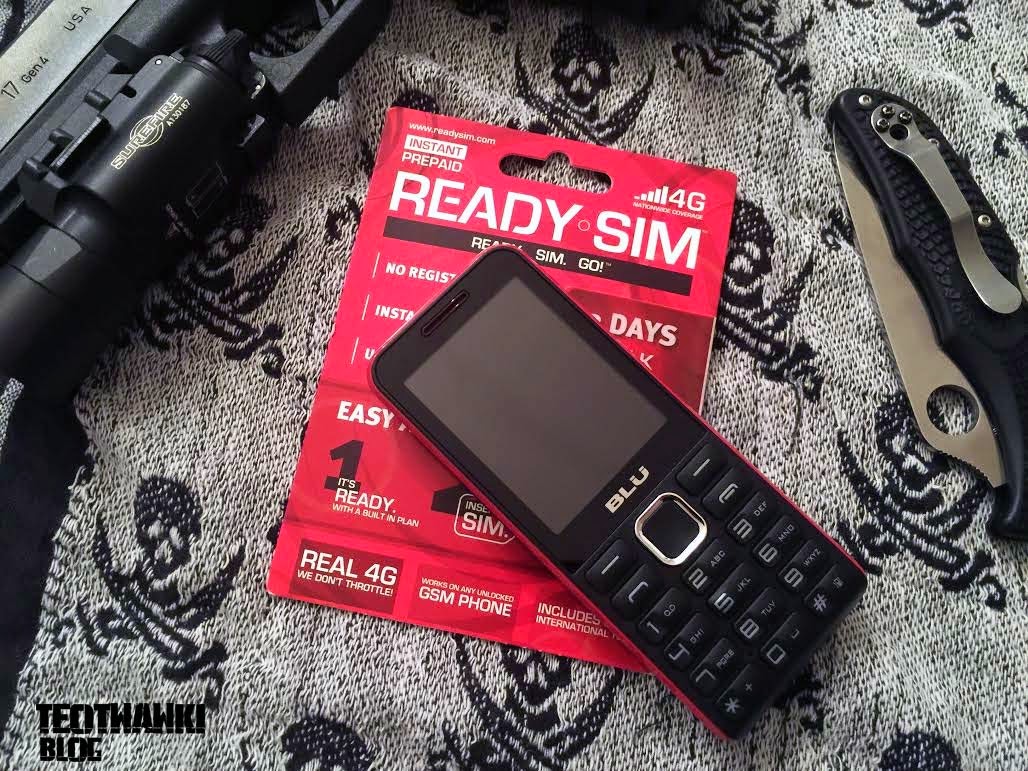
How To: Burner Phone

Chances are, you've probably seen a TV or movie where a Jack Bauer-type character, on the run from big bad evil, uses cheap throw away phones to communicate unnoticed.

Commonly known as a burner phone, a backup, essentially disposable phone isn't only useful for secret agents and criminals. There are a long list of reasons why having a spare phone with a different phone number might come in handy -- lose/break your primary cell phone, selling something via Craig's List, traveling and don't want to risk your $900 smart phone, and so on.

Commo is your lifeline, so you want to do what you can to protect it.

So--how to set up a burner phone? It's actually very easy and 100% legitimate and legal.

Disclaimer: For lawful and responsible uses only While you can get a bit of anonymity and privacy with a 'burner' phone like this, don't do anything dumb, offensive or illegal.

7/30/13

Walkie Talkies (Basic Comms Gear)

Since the characters in You Took Away Tomorrow make fairly frequent use of walkie talkies, I've had a few requests for a post on the matter. I'm not an expert when it comes to radios--I've tried to get interested in 'em, but so far it hasn't happened. Time, attention and resources have been devoted elsewhere.

With that in mind, here's my take on the matter of walkie talkies for short range communication between group members

When talking the subject of survival comms, HAM radios are often amongst the first to come to mind. But, if you're looking to communicate with a specific group of folks--your survival group/buddies--they're probably not particularly interested in the time/effort/dollars requirement to get licensed and set up on HAM.

If your group is that dedicated, awesome.

But, if you're the only guy with a HAM radio, it's not going to do you a lot of good for communicating within your group.

For simple communications in your immediate area, something that is affordable, readily available and with a low learning curve is often your best bet.


10/3/12

Prepping on $40 a Week: Headlamp

If you've never used a headlamp when working in the dark, it's a life changing experience. Both hands free, no light in your mouth and light wherever you look. For working in the dark, it's the way to go.

Between our BOB and EDC, we've got an AA radio and an AA flashlight, so it'd be a bit kooky to go with another battery type for this series. Most headlamps seem to come in AAA x3 variety, and when you find an AA headlamp, it's often got big ol' 4 battery pack--usually with little in the way of extra battery life or brightness to compensate for wearing a brick on the back of your head.

So you have to hunt a bit to get something in AA, in a good size, and in our price range.

Luckily, Fenix makes an excellent headlamp that fits the bill, the HL21. Max of 90 lumens, mid of 43 lumens, low of 3. Two to 53 hours of battery life. The 90 lumen is very bright, and the 43 lumen is more than enough for navigating and general use.

Waterproof to IPX-8 standards...IPX-8 means "constant immersion" in water > 1 meter. So ya, wear this thing out in a storm...no big deal.

Comfortable enough...not the best headlamp I've worn in terms of comfort, but not the worst. Can be removed from the headlamp mount/band if you want to use it elsewhere.

Best of all - it runs on one AA battery. One! A lil' four pack of spare batteries in your kit will give you a week's worth of evening lighting, easy.

Price from Amazon is $34.95 shipped.

Which leaves us enough money to pick up a decent whistle--a handy thing to have. The Wind Storm claims to be the whistle of choice for Special Forces - bet you didn't know there was a Tier 1 whistle of choice, eh? It's tough, loud and works when wet, which is all that I ask for in a whistle. The Fox 40 usually gets the nod, but they're around $7, and the Wind Storm is under $5 and Delta Force uses 'em.

That'll eat up the $40 budget for the week.

Next week, we're moving into putting together a basic, low-cost food storage supply.

6/12/12

SAR Eclipse Signal System

The SAR Eclipse Signal System/boot model
Those who read through my personal PSK write up may remember complaints about finding a signal mirror that was compact enough to fit into tight spaces--a crammed survival tin, wallet or similar. The SAR Eclipse Signal System is exactly that--and it's well made, functional and pretty cool, too.

The SAR Eclipse comes in several different flavors, and I opted for the boot model, the most compact. It is two pieces, riveted together - the top, protective piece with a SOLAS dot for night time visibility, and the mirror underneath. The top piece has a lip bent into the top edge, which works as a clip for holding the Eclipse in place inside a wallet, on some spare webbing, or even as a money clip.

The overall package is roughly dog tag in size and the weight is negligible; it could certainly be worn as a necklace.

As a signal mirror, it works quite well and quite intuitively. If you've ever annoyed someone by reflecting light off of a watch face, you can figure out the Eclipse. Light reflection is very good, and used properly, should be visible from long distances. Aside from signalling, a small mirror is a handy thing to have for other purposes, too.

Thumbs up for this one--I will probably be ordering another few in the near future.


Available from SAR Global Tool >

12/15/11

Reader Submission: Multi Use Whistle

 The soda can whistle inspired reader Dmnhunter to pass along another whistle design. Pretty cool, plus it's multifunctional!

It is very easy to build and on the go can be built very quickly with nothing more than a knife and a rock to sand down the sharp edges. Material for it can be found anywhere in the world! I choose to use a piece of stainless steel banding strap I found on a shipping box. roughly 3" x 1/2". Fold it in half and drill a whole through the center and you have a really loud whistle. I drilled my hole, but have built them on the go out of pieces of soda cans and driven a nail through it or used the awl on my knife.

And if you order now! I did say multipurpose!!!

12/8/11

Pop Can Whistle


This is a potentially handy little whistle that you can make from an aluminum soda pop can. It really works and sounds like a legit whistle!

Click below for the step-by-step instructions!

3/23/11

Review: Sony Pocket Radio

I think everyone should have an AM/FM radio amongst their survival preparations. Being able to tune into news and emergency broadcasts is a pretty big deal in a disaster/SHTF situation.

After a horrible experience with a DOA Kaito pocket radio, I returned it and ordered an inexpensive little Sony pocket radio, the ICF-S10MK2. For $9.99, it was worth a shot.

This little guy is actually pretty awesome. Best of all, it actually works!!! Reception is very good and the tuning wheel quite sensitive and easy to work with. The station marks aren't particularly accurate, which is a small annoyance but easy to work around. I can get all of the stations that I normally get on my truck radio, very clearly, with no static. The speaker is surprisingly good for a $10 radio. It's clear and can be cranked up to a surprisingly loud volume, though you get distortion towards the upper end of the volume. But definitely puts out enough noise to listen to in a decent sized room.

The radio runs on a pair of AAs; I haven't done much battery-life testing but so far-so good. It's definitely not a "hard use" radio--it's made of inexpensive plastic--but it should hold up to use. I've actually dropped mine accidentally onto bare tile floor, with no negative consequences, which was honestly a little surprising.

There's a headphone jack and a little wrist lanyard, and that rounds out the features on this little guy. It's pretty barebones and basic, but it works and it's $9.99. Definitely a very good choice for an inexpensive, lightweight emergency radio. Throw some cheap earbuds and a few sets of batteries, maybe spray-paint it a more tactical-friendly color (OD green, baby!) and you're good to go. You can pick up the Sony ICF-S10MK2 pocket radio from good ol' Amazon.

2/16/11

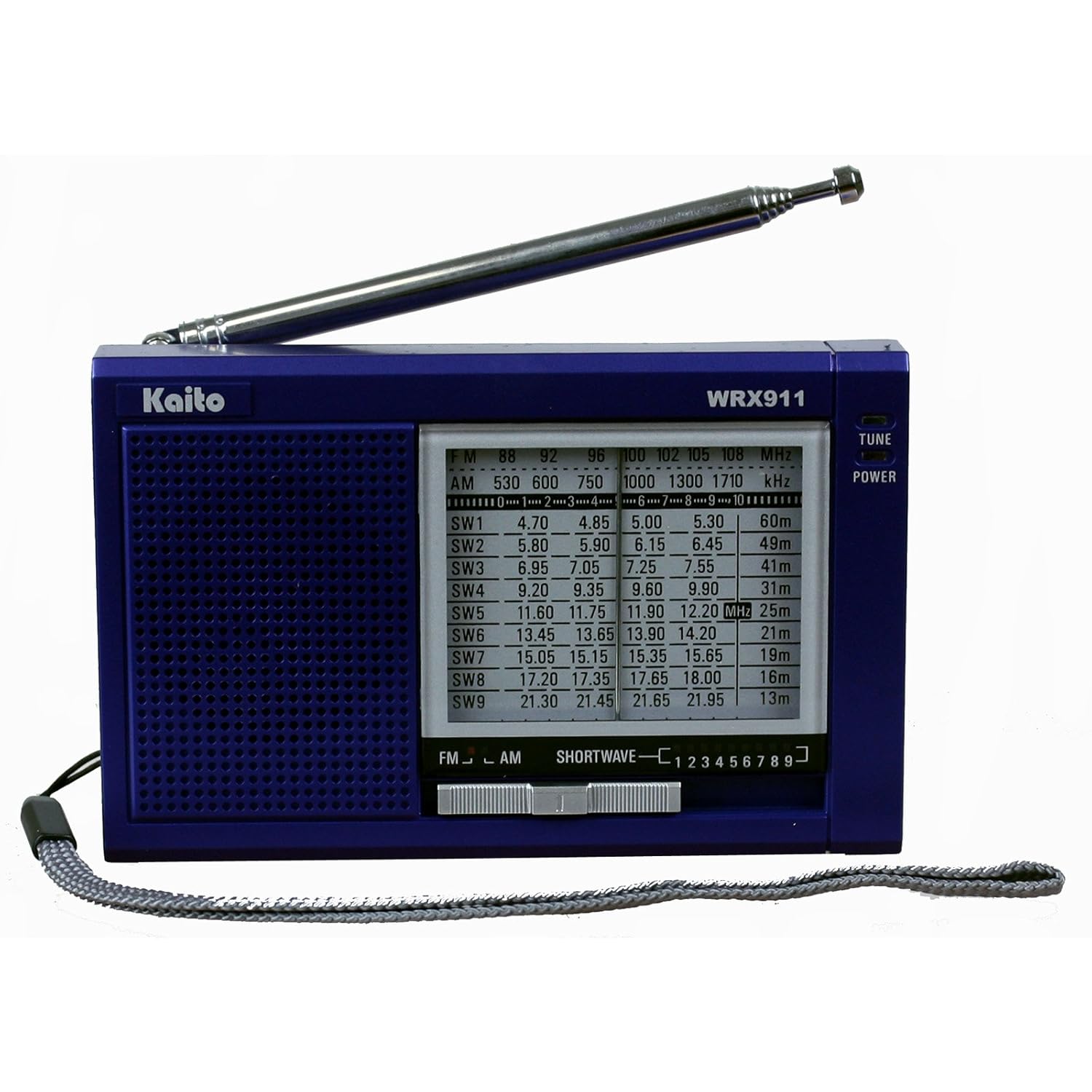
Review: Kaito WRX 911

Don't waste your time.
I bought a Kaito WRX 911 radio based on the positive reviews on Amazon. I wanted something portable and and in the $20, mostly for use in case of an extended loss of power. Keep up with the news and so on. I have gobs of AAs and the ability to recharge them, so the pricier Grundig/Eton radios, with their handcrank ability, weren't particularly needed. Shortwave was a plus, though I've rarely ever been able to get much on the SW bands on the rare occasion that I've checked. I know Kaitos are a cheap, Chinese produced radio, but all of the similar pocket sized radios are also cheap, Chinese made. This radio would do, I told myself. Wrong.

Radio arrived today. Cheesy made-in-China, dollar-store-esque packaging. Opened it up. Cheap, flimsy plastic. But whatever. As long as it does the job, right? It doesn't come with batteries, so off to the battery drawer. Two AAs. One goes in...and doesn't slide in deeply enough to seat or allow the 2nd AA into the radio. Not a good sign.

I pushed the battery and with a little effort was able to get it into place. Second battery inserted. Only now there's too big of a gap between the batteries and the connectors...no contact, no power, no functioning radio. The first battery, the one that wouldn't go in, was too deep. 

After a few minutes of various troubleshooting--trying different batteries, trying to adjust the batteries to sit just right--I realized I was wasting my time. The Kaito WRX 911--at least the one I received--is a piece of overpriced junk. It's going back to whence it came, as soon as possible. 

Guess I will need to spring for something a bit better/more durable/reliable...another reminder to buy quality, no cheap crap. The Eton Microlink is only a few bucks more and should be worlds better.

5/26/10

Shoppin' for a shortwave

I suck. I do not own a portable radio. Sad. At one point had a pretty good little portable AM/FM, but that was about 6 years ago. Not sure where it went to. Then for several years I was anti-radio; let's face it, most of the music stations suck something fierce. Then I got my little Ford Ranger, which came only with an AM/FM radio. Not even a cassette player--just AM/FM. I was commuting 25 miles each way, so I became very familiar with the area's radio stations and found that--shocking--there was some decent stuff on the radio. I spent many long hours, stuck in traffic, listening to NPR and other news stations.

In this day of iPods and Internet radio, lame-o AM/FM radio is often forgotten. Most people have no clue what a shortwave radio is. But a good radio is a surefire way of getting up-to-the-minute information while on the move or without an internet connection--backpacking, camping, hiking, traveling, etc. The .gov has emergency broadcast systems set up to respond in cases of emergency and natural disaster. It's a survival kit no-brainer.

These days, some phones and MP3 players have AM/FM radios built right into them. Even my current POS Nokia phone has one--a surprisingly decent one--though it requires a headset to function. I bought a headset at the dollar store and keep it in my EDC bag. A built-in radio is a pretty good feature to look for; keep it in mind if you're in the market for a new phone or media player.

That being said, I want a more robust and stand-alone device for my EDC/travel bag and for using around the house. Something with shortwave capability--I have memories of playing around with my dad's Sony shortwave as a kid, getting in transmissions from what I guessed to be Europe. Needs to be pocket sized, run on AAs, reasonably sturdy, and ideally around $30.

The Kaito KA202L looks to be the best fit, and has the added benefit of having an alarm clock and an LED light, potentially handy when traveling. This looks to be basically identical to the GP4 radio sold by County Comm. I'm still shopping around though, so if anyone has suggestions, let me know!

3/18/10

Satellite phones for Survival?

I was watching 24 the other day, where the head bad guy was using a satellite phone to further his evil scheme. This got me thinking--a sat phone could be pretty handy in a localized disaster--in a 9/11, Katrina, Haiti or Chile type situation, local cell and landlines are knocked out or overloaded with traffic. So, I did some digging to see if sat phones--cool as they are--would be a viable option.

Compared to Ham/Amateur Radio
When we talk about survival communications, ham radios are typically the first to come to mind. I'm no expert in hams, but I've done some reading. They have a lot going for them. But, they also require tests, licenses and specialized knowledge. Small, portable handheld ham radios need to be within range of a functional repeater to get much distance. Even using a good base station radio, if you're not within range of a repeater, you're looking at using big antennas and bouncing your signal around the atmosphere, which may or may not work. They require lots of tinkering and are not always the most reliable form of communication; often times ham ham buddies will give up talking over the radio--because of poor signal, interference, whatever--and just call each other on the phone. If I'm wrong on this, let me know--the above is my understanding based on what I've come across.
 
When compared to ham radios, sat phones are pretty much plug-and-play. They don't require much in the way of special knowledge. They don't require licenses, use of repeaters, phone patches or anything special. You just dial the number, wherever you are on earth. Simplicity has a lot going for it.

Sat phones are definitely not as "standalone" as hams are. First, they need the satellites to be working. Sat phone to sat phone calls just stay within the sat network--no landlines involved. However, calls to normal landlines or cell phones involve the cell/landline infrastructure. If you're in a disaster area, calling a conventional phone in an outside and unaffected disaster area with operating phone infrastructure, you'll be ok. But if they are affected--if you're trying to contact someone on a compromised network--then you'll be just as screwed as everyone else. So, for a nationwide or worldwide SHTF situation, a single sat phone may do you limited good. Even if you had several people with sat phones to communicate with, they'd only work as long as you could get access to the satellite network.

Cost (It Ain't Cheap)
Price is also definite consideration for a sat phones. A new sat phone will run you around $1,500, although used models are available on eBay at a substantial discount (under $500). Once you have the phone, however, you will need to activate it and then purchase airtime like a cellphone. This isn't cheap--but it has dropped in price in recent years and should continue to drop in the future.

Iridium is the big name in sat phones--they've got the only truly worldwide network. The best deal that I've found is their 222 minute prepaid sim card, which can be had for $450 and is good for one year (activated as soon as you purchase it). Cheaper cards are available, but they expire in 1-3 months. You can of course get more minutes for more money--500 international minutes for $675, etc.  You can subscribe to a plan--but the basic plan, no minutes included plan, is $40/month or $480 for a year. Outgoing calls on that plan will run you $1-$2/minute, so the 222 minute prepaid sim is cheaper and gives you some minutes to work with. Basically, to have a functioning sat phone, you're looking at about $500 a year for a couple hundred minutes.

Globalstar, Iridium's main competitor, has less expensive phones and similarly priced plans. They are currently in the middle of launching new satellites, though, so you may want to wait until that happens to make any purchase.

Like with all things, deals can be had. eBay, for example, has a few used Iridium phones with several hundred remaining minutes for well under $1,000. People buy these for a trip or expedition and then sell 'em off quite regularly. As always, know what you're buying before you drop the cash!

It could make sense...
So--assuming you can afford one--when would you need a sat phone? Here are three situations that come to mind.

Off Grid and Very Mobile: If you spend lots of time in areas without reliable phone networks--off roading, backcountry skiing, hiking, exploring, out at sea or otherwise off grid--a sat phone could come in handy fairly regularly and would be smart to have around just in case. There's not really anything comparable in capability. Want to call home from the top of Mount Everest, the middle of the ocean, or the Island from Lost? A satellite phone is your only option.

Frequent Travelers: If you travel internationally or outside of your home region frequently, a sat phone could be a good insurance policy to make sure that you have communications ability back home. For example, if you were in Chile for business when the earthquake hit, you would have the ability to call home immediately and tell family and co-workers that you were ok, get a read on the situation, and start planning your evac immediately.

If you don't have the time/interest to get into Ham radio: For the most part, a ham radio set up will probably serve you better for SHTF situations in the US, which has a robust system of repeaters and an avid amateur radio community. It should also cost you quite a bit less than buying a sat phone and keeping it active. But, if you don't want to study up for your ham license and spend the time to figure it all out, then a sat phone is your alternative. It will give you simple-to-use phone communications with anyone with a sat phone or an operational land/cell network. Personally, I fall somewhat into this category--I'm just not that interested in ham radio.

Of course, the more the above apply to you, the more useful a sat phone will be to you. If you frequently travel off the grid internationally, a sat phone would be very wise indeed.

Conclusion
I think sat phones have a way to progress still--prices need to drop and I'd like to see some kind prepaid "emergency" sim card that one could just hold onto until an emergency came along. As-is, your minutes expire or you're paying $40-$50 a month for the "insurance."  My budget is unfortunately not that flush at the moment. However, if I had the money, I'd probably invest in one. Sure, it wouldn't do me a ton of good in a sudden nation or worldwide TEOTWAWKI scenario, but for local/regional disasters or troubles while traveling off the grid/abroad? Super useful.

And hey, they're Jack Bauer-approved, which is always a plus.