> TEOTWAWKI Blog: $40 a week

Pages

Showing posts with label $40 a week. Show all posts

11/7/12

Preparing on $40 a Week: Last Week & Index!

It's over (for now!)
This has been a fun series to write, and it's actually helped pull me buckle down and fill in a couple gaps in my preps, too. This is our last week of the series - if you've been following along, you've made it to the end!

This final week is pretty simple. Take $40 in cash and add it to your bug out bag (or, if you're disciplined, a back corner of your wallet). $40 isn't much, but it'll fill up a tank of gas, pay for a cab, buy a week worth of cheap food, and so on. It's also the start of an emergency savings - add more funds to it as you can, and don't spend it unless there's a real emergency.

If you've been following week-to-week, you should have some money in the "bank" - around $15. I'd recommend spending that money on a quality knife sharpener...I'm partial to this model - the Eze-Lap brass sharpener. Good for getting a basic edge going and then strop to get a finer edge as needed. Works pretty well and the all-metal construction will last you through years of hard use.

If you've missed a week here or there, here's the whole list of posts. You can also see them by clicking on the "$40 a week" label at the bottom of the post.
  1. Everyday Carry Knife
  2. Everyday Carry Light
  3. Bugout Backpack - they've jacked the price up a bit on these, but still a good deal!
  4. Survival Knife
  5. Fire Gear & Container
  6. Sleeping Bag
  7. Shelter
  8. Water Filter
  9. Budget Individual First Aid Kit
  10. Protective Gear
  11. Chopper/large cutting tool
  12. Bug Out Food
  13. Toiletry Kit & Odds n' Ends
  14. Headlamp
  15. Food Storage Week 1
  16. Food Storage Week 2
  17. Food Storage Week 3 & Barter Goods
  18. Start emergency savings
Yep, your total spend will be around $720 when you total it all up - the price of an entry level AR-15 or a decent long-weekend vacation. Nothing to sneeze at. But, it's gear that will last you a long while, and it's stuff that you can put to use every day, not just leave sitting in a closet/trunk/garage.

The preps we put together are by no means exhaustive, but they're a dang good foundation. And, if you want, continuing regular $40 investments in preps quickly adds up - food, water, fuel, savings, etc. Just keep at it!

Thanks again for following along with this series - this was the first time I've done something this extensive & weekly on T-Blog, and it was, I think, a big success. This certainly is not the last you'll hear of the $40 a week concept or budget minded prepping in general. Stay tuned!

10/24/12

Prepping on $40 a Week: Food Storage Week 3 & Barter Goods

Guys and gals, we're almost at the end of this series! Hold on tight.

So for the past couple weeks, we've put together a simple, low-cost food storage from rice, beans, and some assorted canned goods and shelf stable stuff. It's not glamorous, but it's a month of shelf stable food for $80. The rice and beans will provide the calories, carbs and protein you need, and with the addition of some oils and the assorted canned goods, you should have adequate fats, too.

Unfortunately, you'll be lacking in many other vitamins and nutrients. While it probably won't kill ya, we're going to add a multivitamin to the mix to alleviate any problems that might come from eating rice, beans and canned stuff for a month straight (aside from boredom).

The least expensive multivitamins that I have found come from Costco...the Kirkland brand. They come in big ol' bottles of 500 tablets. If you don't have a Costco membership, don't fear, you can buy 'em on Amazon for about $19. The price at Costco should be a few bucks less - around $15.50. That's dirt cheap for quality vitamins - the Wal-Mart brand is more than twice as expensive.

Of course, you probably won't need 500 multivitamins unless it's a really bad apocalypse, or if you're spreading 'em around a large family.  Don't worry, though, multivitamins can make good barter material.

Others will be eating much worse that you will, and vitamins will become pretty desireable things in an extended emergency, which is the kind where barter comes into play. If your teeth start falling out, you'd be willing to trade quite a bit for a handful of vitamins.

Certianly, multivitamins are not the end-all of barter goods, but we want to have 'em on hand anyways, so why buy in quantity.

So, the multivitamins will eat up $15-$20 of our budget this week.

The rest, we're going to roll into barter goods. The best kind of barter goods, in my opinion, meet the following criteria:
  • Useful if you don't barter them away--something you will use/consume
  • Inexpensive in normal times
  • Hard/impossible to reproduce post-collapse
  • Lightweight
  • Long/indefinite shelf life
  • Stuff that the average household won't have in quantity
There's no one "right" thing to stash for barter, and really, a lot of it will depend on your individual circumstances. You should diversify your barter stash, too--if you have 500 lighters but no one wants lighters, you're outta luck.

Here's a short list of ideas: lighters, matches, cheap candles, all kinds of medical supplies, vitamins (got 'em!), batteries, cheap knives, tarps, cordage of various kinds, heavy grade garbage bags, fishing hooks & line, rat traps, needles and thread, work gloves, small propane tanks, N95 masks, small candies, chocolates, spices, non-hybrid seeds and the old stand bys of alcohol, coffee and tobacco.

Food and ammo can work, too - but may not want your trade partner knowing that you have a surplus of either, and there's concerns about having bartered ammo used against you. Sugar, honey, and other sweet things would be in high demand.

One special mention item is calcium hypochlorite, which is usually sold as pool shock. It's shelf stable, and can be used to purify water in large quantities (like thousands of gallons). This EPA page has the how-to. If you can't find the right stuff in local stores, Amazon has 6 pounds for $27 shipped.

Here are a few barter item deals - feel free to share others in the comments section:
  • 50 lighters for just over $14 shipped
  • Boxes of matches from the local grocery store - get 'em in match books or smaller boxes for easier trading. Usually around $2-$4 for 500.
  • My DIY survival candles
  • 100-packs of tealights from Ikea - if you can survive the rest of the store
  • Baby wipes from Costco - not just for the babies! Much more effective and multipurpose than ol' fashioned TP.
  • Amazon has some decent, dirt-cheap knives that would make good trade bait or handouts - here and here for two examples that come with firesteels!
Also, keep in mind your skills and current equipment--ser. You should have a Sawyer water filter that will be good for a million gallons of water - properly set up, you could be filtering drinking water for several households, bottling for trade, etc. That's huge. If you're decent at sewing, you might want to make up some simple bags/packs (or have the knowhow and materials to do so). Got a smoker in the backyard? Make sure you've got extra wood, spices, etc. just in case. You get the picture.

Why do we care about barter? Well, you can't plan for everything, and there are some things you will forget, run out of or break and need to replace. You will probably also need help from others at some point--even if it's just for an exchange of information--and they might want some encouragement. Even if you have everything you could possible every need for the apocalypse, sometimes you just want to improve morale or make a new friend.

Got any favorite barter items? Disagree with something? Let us know in the comments sections.

10/17/12

Prepping on $40 a Week: Food Storage Week 2

Tactical beans.
Last week, we recommended picking up a case of white rice, and a few dollars worth of extra canned goods. This week, we're going to complete the traditional rice & beans food storage by adding some beans to our pantry.

Beans come in dried and canned variety. Dried are a lot cheaper, but the prep work is intensive - soaking and then cooking takes 45 minutes to 90 minutes. That's a lot of time, and it's a lot of fuel. If you've got say a woodstove and plenty of wood, not such a big deal. If you're cooking off of a camp stove with a limited supply of propane, it becomes a bigger deal quickly.

Canned beans are a bit pricier, but they are really convenient and18 make using up your beans much easier. Open can, add to dish. We add them to soups, chilis, serve them as a side dish and mash 'em up for refried beans.

We store black and pinto beans. I generally like varieties that come with some kind of seasoning out of the can - they're usually pretty tastey and don't require much extra work to make 'em into a good dish. I wouldn't be afraid to mix up your bean variety - throw in some baked beans, chilis, etc.

Cans cost about .69 to $1.29 or so. Look out for sales and buy cheap brands. If they do have seasoning, I'd try out a can of two before clearing the shelves.

Beans are loaded with protein and fiber, and pretty dense calorically, too. One 10-oz can of black beans, as an example, will have around 420 calories, 18 grams of fiber, 24 grams of protein.

Since we're gunning for a month worth of food for a single person, go ahead and pick up around 30 cans of the beans of your choice. So, depening on the brand and price you'll pay, you're looking at $20 to $30.

Rice and beans have zippo in the way of fats, so you'll want to add some when you cook 'em up. Olive oil is what is usually called for in recipes, and most people already have some in their pantry. If you're low on it, pick up a bottle to keep in reserve. Other oils will do in a pinch as well. Oils need to be rotated around once a year, so it doesn't make sense for most people to stock up a huge quantity.

If you've got extra money left in your $40, go ahead and spend it on some additional canned goods/shelf stable food, to help add some variety and supplement the standy-by rice n' beans. Ramen/cup-o-noodles might not be a great health choice, but they're cheap and they're food. Some bulk quick oats or bisquik can give you a change of pace for breakfasts. Cans of meat, soups, stews, peppers and tomatoes can add some variety, too. If your spice cupboard is lacking, maybe make a few additions - salt, pepper, bullion cubes, bulk spices and sugars are cheap and one can do a lot with 'em.

Our case of rice and a can of beans a day will stretch us over that month that we're looking for - it's  approximately 66,000 calories, or a healthy 33 days worth of 2000 calories a day. Add that onto whatever food you already have at home, plus the supplemental food you've bought this week and last, plus the 3 days of food in your bug out bag, and you're sitting fairly good. In the CONUS, I don't know of anyone in recent history who has been unable to access outisde food for over a month, so it is a pretty good baseline.

Next week, we'll finish off the low-budget one month food supply and move into the last portion, barter goods! Stay tuned. It's been a fun ride and we're almost done.

10/10/12

Prepping on $40 a Week: Food Storage week #1

The point of view of this series is getting someone who has nothing off to a solid start with a capable baseline of gear and supplies, without breaking the bank. As we've seen, it's very possible.

With that budget stretching point of view in mind, we move into food storage. Having some additional food kept at home is a wise thing--gets you out of that "3-meals-from-anarchy" demographic for starters.

You can get really fancy with food storage and spend hundreds, thousands on freeze dried stuff. But, that doesn't need to be the case--there are some really great deals out there on foundational food storage stuff (staples!) if you know where to look and who to ask.

10/3/12

Prepping on $40 a Week: Headlamp

If you've never used a headlamp when working in the dark, it's a life changing experience. Both hands free, no light in your mouth and light wherever you look. For working in the dark, it's the way to go.

Between our BOB and EDC, we've got an AA radio and an AA flashlight, so it'd be a bit kooky to go with another battery type for this series. Most headlamps seem to come in AAA x3 variety, and when you find an AA headlamp, it's often got big ol' 4 battery pack--usually with little in the way of extra battery life or brightness to compensate for wearing a brick on the back of your head.

So you have to hunt a bit to get something in AA, in a good size, and in our price range.

Luckily, Fenix makes an excellent headlamp that fits the bill, the HL21. Max of 90 lumens, mid of 43 lumens, low of 3. Two to 53 hours of battery life. The 90 lumen is very bright, and the 43 lumen is more than enough for navigating and general use.

Waterproof to IPX-8 standards...IPX-8 means "constant immersion" in water > 1 meter. So ya, wear this thing out in a storm...no big deal.

Comfortable enough...not the best headlamp I've worn in terms of comfort, but not the worst. Can be removed from the headlamp mount/band if you want to use it elsewhere.

Best of all - it runs on one AA battery. One! A lil' four pack of spare batteries in your kit will give you a week's worth of evening lighting, easy.

Price from Amazon is $34.95 shipped.

Which leaves us enough money to pick up a decent whistle--a handy thing to have. The Wind Storm claims to be the whistle of choice for Special Forces - bet you didn't know there was a Tier 1 whistle of choice, eh? It's tough, loud and works when wet, which is all that I ask for in a whistle. The Fox 40 usually gets the nod, but they're around $7, and the Wind Storm is under $5 and Delta Force uses 'em.

That'll eat up the $40 budget for the week.

Next week, we're moving into putting together a basic, low-cost food storage supply.

9/26/12

Prepping on $40 A Week: Toiletry Kit & Odds N' Ends

An odd n' ends week as we round up a bunch of stuff to help top off our budget bug out bag. This week, we will be adding:

  • Toiletry Kit
  • Pocket AM/FM Radio
  • Compass
  • AA batteries to power our flashlight and radio
A toiletry kit isn't a must-have survival necessity, but it is a major morale booster and, outside of a very short term emergency, hygiene does become a real issue. Folding toothbrush, travel sized toothpaste and deodorant, wipes/hooahs and a 2-oz travel bottle of Dr. Bronner's Magic Soap. The little bottle of Dr. Bronner's goes a long way, and you can actually use it to brush your teeth if you don't mind a little soap flavor and want to save the ounce or so that a travel sized toothpaste weighs. Pack it in a freebie airline toiletry kit (or a quart sized freezer bag or a dollar store toiletry case) and you're good to go. With the Bronner's, you should be at around $10 for the toiletry kit.
For a budget pocket radio, I really like this Sony model. $10, runs off of common AAs, great battery life, and surprisingly good functionality. Sure, there are nicer radios, but for tuning into emergency broadcasts and what have you, it works well. I've had mine for a year and a half now; zero problems and has held up well. I would throw it in a freezer bag and keep it with your clothes or sleeping bag to avoid getting smashed.

For a basic, budget compass, the Silva Polaris is tough to beat at $12. Getting lost while in an already crappy situation is a bad thing.

AA batteries are, well, AA batteries. We buy the big brands (Energizer, Duracell) and Kirkland (Costco brand), though we've been switching over to Eneloops for our battery needs (high quality pre-charged rechargeable batteries). Taken what you have left over this week and buy some AAs of your choosing. I like to have at least two sets of spares in a larger kit. Take note of the expiration date when buying.

Budget: This week should pretty much exhaust the $40 - if you have a buck or two left over, roll 'em into your bank.

Editor's Note: Last week, I mentioned we'd be wrapping up the bug out bag portion this week. I went back over the previous posts and noticed that I'd forgotten a key item (headlamp) and a couple little things I'd like to include, too. So, we'll be taking one more week on this portion of the series. Stay tuned!

9/19/12

Prepping on $40 a Week: Bug Out Food

We're nearing the end of the bug out bag packing list. This week is food, next week is some odds and ends. Then we're going to look at building a very basic, budget food supply for one person to last a month, and we'll wrap up with some barter items, and that will wrap up the $40 a week series.

Some guys don't pack much in the way of food -- if you can go for days without much to eat and not have your performance suffer dramatically, then good on you. But most of us will start to notice a fairly significant drop off in performance after a day or two, though adrenaline can mitigate some of that. We're putting together a survival kit, so it makes sense to add some food.

To get rolling, make sure you've read through last week's tip of the week on the calorie-to-weight ratio. Calorie-to-weight, shelf life and prep requirements are going to be the main requirements you look at when sorting out your food. Use a baseline of 100 calories per ounce.

9/13/12

Prepping on $40 a Week: Choppers!


When we chose our budget survival knife I mentioned that we'd be picking up several tools instead of trying to use a big, do it all Rambo knife. When you try to have one tool that does it all, you end up with compromised performance. A fixed blade knife can do a lot, but it can't do everything, and it can't do everything well. So, we'll be adding a bigger tool for serious cutting/chopping work to our budget survival kit.

Instead of recommending a specific tool, I'm going to run through several excellent choices that fall within our $40 price range. This tool choice is more dependent on your area of operations--where you live. Someone who lives in an urban center will have different needs then someone who lives in the middle of a forest, and someone who lives in the desert or swamp will again have different needs.

9/5/12

Prepping on $40 a Week: Protective Gear


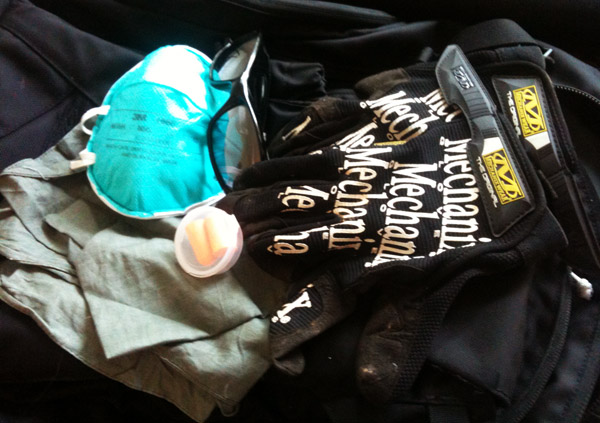
Things like gloves, hearing protection, glasses, and so on are often overlooked when packing a survival kit. Good luck surviving with an eye fragged by flying debris or if your hands get shredded falling on broken glass. Protecting your body from the omnipresent dangers post-disaster is a pretty big deal, so don't slack on it.

We're going to be adding a good pair of work gloves, eye protection, ear plugs, an N95 mask and a bandanna to our budget kit this week.

The gloves I have used for several years now are original Mechanix gloves. They are not as hardcore/armored as many tactical gloves on the market, but they provide some decent protection while retaining dexterity. They are also quite affordable. Mine are the original black/white pattern, but I would go with the new black/black or Coyote color patterns if buying new. Amazon has 'em for $15.99, and Lowe's hardware also carries a pretty decent selection of them.

8/29/12

Prepping on $40 a week: Budget IFAK

Contents of an IFAK - clockwise from the top: NPA, TK4 tourniquet in the middle, combat gauze, gloves, H&H gauze
and an Isreali bandage.
Tactical Combat Casualty Care has been pivotal in reducing preventable deaths in combat. A central part of TCCC is the individual first aid kit (IFAK). An IFAK is not a boo boo kit full of bandaids and cough drops. Instead, it contains critical equipment for addressing preventable death from wounds sustained in combat.

For a survivor, having these same supplies and the knowledge on how to use 'em can be a life saver.

You can buy very nice and capable IFAKs, premade and ready to go. But, they will run you around a hundred bucks, outside our budget. Never fear, you can put together a similar kit for within our $40 budget--yep, really.

How? We'll walk you through it - click below!

8/22/12

Prepping on $40 a Week: Water

Water is one of your top concerns in any survival scenario - no water, no live. And sure, you can drink unfiltered water and be ok...or you can get horribly sick and die dehydrated from the squirts.

For a long time, water filters kind of sucked. Heavy, unweidly, expensive, lots of work for little reward and they'd generally wear out pretty darn quick, too.

Then along came the million gallon guaranteed Sawyer PointOne, a truly disruptive technology for the water filtration market. Sawyer's filters are derived from kidney dialysis technology --this particular filters down to .1 microns - better than almost anything else out there. And it weighs all of a few ounces.

As far as I'm concerned, it's the best choice for light and fast water filtration, and it just so happens to be within our $40 a week budgetary reach.

8/15/12

Prepping on $40 a Week: Shelter

A soldier hunkers down during SERE training.
Image from defenseimagery.mil.
Shelter is one of those things where you can go in a huge variety of directions--full blown tent, ultralight tent, tipi, hammocks, tarps and many permutations of them. Heck, you can go with no shelter at all if you've got the proper tools, knowledge of building survival shelters and some time--or if you can rely on existing shelter.

We surveyed the tribe on our Facebook page (like us, we're going to do a give away at 1000 likes!),  and it turns out tarps and tents are tied for your top choices for bug out shelter.

A big part of your shelter choice will be informed by where you live--Montana is going to be different than Arizona. So, take the recommendation here with that in mind. Personal preference also comes into play, big time.

Shelter is also one of those "might use" items in a BOB, too. Your plan #1 is probably not going to be to hunker down in the woods somewhere. Shelter that you're going to pack with you is only typically going to come into play if there's no viable pre-existing structure that you can hunker down in--no friend's/family's homes, no hotels, no nothing. If I've got a working vehicle with locking doors, I'm probably going to hunker down in that before I strike camp somewhere, too.

And really, we're talking about bugging out--getting away from danger as quickly as possible--not a luxurious back country camping trip. You'll want to be moving as fast and as long as possible, and only stopping and holing up if you have to.


8/8/12

Prepping on $40 a week: Sleeping Bag


A good sleeping bag is an oft under estimated thing, but if unable to sleep because you're freezing your butt off, you will be wishing for one. Of course, a sleeping bag is useful beyond that-camping, crashing at a friend's place, etc. They are handy things to have around, and every family member should have at least one.

Standard big box store sleeping bags are both too heavy and too bulky. Backpacking brand sleeping bags are nice, but they generally run well over our budget. Some budget minded folks instead go with poncho liners or surplus wool blankets, but in my experience, neither are a great substitute for a decent sleeping bag. 

There are luckily some good options for sub $40 sleeping bags, and of those, the USGI Patrol Bag is amongst the best.


8/1/12

Prepping on $40 a Week: Fire Gear & Container

It's been way too long since our last entry in the $40 a week series, but we're back. Last time around, we talked survival knives. This week, we're focusing on two bug-out bag essentials--a fire kit and a container for cooking and boiling.

Fire Starting Gear
There's a variety of ways you can go with either, and most of 'em are pretty good. For fire kit, I personally like a butane lighter or two, backed up with a ferro rod/fire steel, and with plenty of good tinder.

Raid your junk drawer or mosey on down to the local grocery store and pick up a pack of your lighters of choice--I generally go with Bic lighters of a lighter color. Bics are pretty sturdy and bomb-proof relative to cheaper brands, and the lighter color allows you to check fuel levels. Having two--one to ride in your pack, one that rides in your pocket while you're in bug out mode--is a pretty good idea. Bust the annoying child lock off too.

7/17/12

Prepping on $40 a Week: Survival Knife


A good knife ranks at the very top of most survival lists, especially when we're talking wilderness survival. The uses are pretty much endless--cutting, skinning, gutting, slicing, carving, whittling, batoning, chopping, stabbing. The Mora knife in its various forms is one of the most common choices among survival experts for good reason. It's affordable--almost all under $30--comes with an excellent, scary sharp blade, comfortable handle AND it's lightweight. Perhaps not surprisingly, it's also our pick for a fixed blade knife for our $40 a week series.

7/4/12

Preparing on $40 a Week: EDC Flashlight


For a long time, I carried only a keychain flashlight as a part of my everyday carry. I worked my way up from Photon lights to the Fenix E01 and finally a Fenix LD01. However, there's only so much performance to be wrung out of a keychain-sized light. If someone can't/won't carry something bigger, or as a backup, they're great. But really, a step up in flashlight size is necessary to start get some really impressive and useful performance.

So, I bought a Surefire E1B, which has become one of my favorite things, and pretty much embodies what I look for in an EDC light. Single battery for ease of carry, yet still kick out around 100 lumens and run for several hours. A "clicky" tailcap is important to me--easier, faster operation and allows for momentary on/off. At least one "low power" mode for battery conservation, and a dead-simple UI--don't make me twist the cap 5 times, throw the light in the air and clap three times to get to another mode. A great pocket clip is also key and what continues to set the E1B apart for me. And, of course, rugged construction--it needs to stand up to lots of regular use, the occasional drop on a hard surface, some level of water resistance and so on.

Of course, a $120 light like the E1B is more than a little bit out of our $40/week budget. I went looking for something that had most of the features that I think a good light needs to have, and I wanted it in a common AA battery--AAs are cheap and readily available locally, so all of our electronics will run off AAs.

I'm really impressed by the light that I tracked down, the Fenix E11--a $26.95 light that performs like a light two or three times the cost.

SnakeDr's $40 Deals


Happy 4th, all!

SnakeDr & OscarDelta have come up with two $40 package deals inspired by our $40 a week series. Very cool!

Deal 1, pictured above, consists of:
  • Hybrid Technora® Bracelet HBK715 Black with End User Adjustment System II (EUAS) x 1
  • SERE Black Ops "V" Cutter (installed on bracelet) x 1
  • Ranger FireSteel & Striker x 1
  • 28mm SOLAS Refelective Self Adhesive Disc x 2
  • Go-Tube with Black 550 Breakaway Pendant Rig (inner core of Jute) x 1
  • FQFOB Black with double inner core of Jute x 1
Deal 2 consists of:
  • Hybrid Technora® Bracelet HBK715 Black with End User Adjustment System II (EUAS) + Jute x 1
  • Go-Tube SOLAS with Black 550 Breakaway Pendant Rig (with inner core of Jute) x 1
  • Micro FireSteel and Ceramic Striker 
These are some great deals - SnakeDr makes the best paracord and hybrid paracord survival bracelets on the planet. He's been a long time friend of the blog, too. Prices include worldwide shipping. Check the deals out here.

6/26/12

Prepping on $40 a Week: EDC Knife


Hope you've got your budgets worked out, because we're diving right into our $40 a week series. We're starting out by building a solid, budget-minded EDC. This week, we're looking at our first selection, a pocket knife.

There are actually a surprising number of excellent choices for under $40; the Spyderco Tenacious, which is a really great knife for around $35, is a very solid pick at this price point. However, remember that we're writing for someone really starting out from scratch and looking to maximize the utility of the limited budget at hand.

With those constraints in mind, I'm deviating from what you'd normally think of in a pocket knife recommending a multitool - the Leatherman Sidekick.

6/20/12

Getting Prepared on $40 a Week: Introduction


Preparing for tough times can be a big, daunting task, especially if you're starting from scratch. This new series of posts looks at how to go from nadda to well prepared on a budget of $40 a week. We'll be going from building a capable, budget-minded every day carry to a capable bug out bag (BOB)/72 hour kit and then onto a month's worth of food storage and a small stash of barter items, all on 40 bucks a week. We're aiming for about a 4 month time frame, with new entries each Wednesday.

We've chosen $40 a week because, while not insignificant, it represents an attainable amount for the average U.S. family. $40 gives us enough to work with in order to buy some quality gear and get things accomplished in a reasonable amount of time.

Budgets are of course tight these days, and you may not be able to swing $160 a month for 4 months. You can, of course, scale the schedule to match your available budget--instead of $160 a month, maybe $80 or even just $40--it'll take you longer, but you can still get it done. You may want to look at cutting back on luxury expenses or selling off some unused items in order to meet the budget. And you're probably not starting completely from scratch, so there's likely a few weeks where you will be able to skip purchases.

We will be purchasing from readily available sources--lots of Amazon (free shipping for the win!), with maybe Wal-Mart, Costco and others--and using readily available prices. We'll be recommending high quality, durable gear that will last through years of use--not cheap junk that will fail you in a time of need. We're going to try to maximize the bang-for-your-buck here, and avoiding low quality gear that will need to be replaced.

Some weeks we'll use all of the $40, other weeks we will bank some for more expensive purchases down the line.

The BOB will be ready for a 72 hours scenario, and food storage will be mobile enough to throw in the back of your vehicle and evacuate. At the end of the series, with your BOB, food supply, and a source of water and fuel, you'll be equipped to survive at home or in the boonies for a month or more. 

We're not going to be venturing into firearms in this series, because, frankly, it would be a lot of "save $40" posts. But, outside of that, we'll be covering everything else prep-related, though.

If you've already got a solid EDC, finely tuned BOB and a pile of food storage, never fear, you'll still get some good into out of this series. You'll probably be able to extract a few ideas and gear recommendations, but we'll also be including "To Do" items if you've already got a specific area squared away. We'll also be looking for your "picks" and ideas in the comments section of each entry.

This week, we're getting geared up, so no purchases. Instead, we've got a short list of tasks to get you ready for Week #1 next week.

Your Tasks for the Week:
  • Evaluate your budget and see what you can accommodate.
  • Do an inventory of your current preparedness and camping gear. If you're perusing this blog, you've probably got some good items on hand already.