> TEOTWAWKI Blog: lighting

Pages

Showing posts with label lighting. Show all posts

7/29/14

Brite Strike APALS - A light in the dark


Testing out Brite Strike APALS as an ultra-compact, low cost emergency light source and beacon. Built in weatherproof adhesive strip allows you to stick 'em where you need 'em. Switch allows you to move through flashing and constant on, and shut the thing off to save it for another day. They're flat versus round, which lets the slip more easily into the tight spaces of small kits.

At $3-$5 a pop and with 80+ hours of useful life, these are a great option for contingency kits or for marking/signalling purposes. Available in a variety of colors, including IR.

7/10/14

Review: Streamlight Sidewinder Compact II

The Streamlight Sidewinder Compact II is about as versatile as you can get. The four color modes (white light, blue, red, IR), each with five brightness levels (low, med 1, med 2, high, beacon) is cool but not particularly impressive. What is impressive is the Sidwinder's ability to run off three different types of batteries - CR123A, AA or AAA.

Yep, you read that right. It can run off of any of those battery types. Streamlight doesn't advertise AAAs working, but they most certainly do. The single cell battery compartment is smartly designed to expand/contract to fit the cell size - it's spring loaded, so it adjusts automatically when you slip a different cell in. And it actually works, too.

12/28/13

Zero Dark Glow Tabs


Serious glow-in-the-dark material. No batteries, no electronics to screw up, infinitely reusable...very interesting. Designed by Snake Dr, with more info at Last Ditch Kit.

11/13/13

Quick Review: Inforce WML

The Inforce WML has been out for a while now and been getting some pretty good coverage in the gun blog-o-world. It's half the price of a Surefire x300, uses 1 CR123A battery instead of two, weighs only a few ounces and still manages to kick off a good amount of light. So, theoretically, it's a got a pretty compelling value proposition behind it.

Figured I'd give one a whirl, intending it for Project 590A1.

Unfortunately, a poorly designed pressure switch kills the good stuff that the light has going for it, at least in this version, from Haley Strategic Partners.

8/8/13

Review: Nitecore MH25 Night Blade - Retina Burning and Rechargeable


Nitecore's MH25 uses some of the latest in LED technology to turn out a retina blasting 860 lumens, making "Night Blade" an appropriate name. The MH25 can run on standard CR123A "primary" cells, or it can run on 18650 lithium ion rechargeables, like the one included in the box. There are lots of bright, double cell lights on the market though, but the MH25 separates itself from the pack with one very handy feature:

The MH25 has a built in micro-USB charging port, allowing you to recharge your 18650 batteries without needing a separate, bulky charger. It's plug-and-charge, the kind of functionality we're all used to with our smart phones and other electric gizmos.

10/3/12

Prepping on $40 a Week: Headlamp

If you've never used a headlamp when working in the dark, it's a life changing experience. Both hands free, no light in your mouth and light wherever you look. For working in the dark, it's the way to go.

Between our BOB and EDC, we've got an AA radio and an AA flashlight, so it'd be a bit kooky to go with another battery type for this series. Most headlamps seem to come in AAA x3 variety, and when you find an AA headlamp, it's often got big ol' 4 battery pack--usually with little in the way of extra battery life or brightness to compensate for wearing a brick on the back of your head.

So you have to hunt a bit to get something in AA, in a good size, and in our price range.

Luckily, Fenix makes an excellent headlamp that fits the bill, the HL21. Max of 90 lumens, mid of 43 lumens, low of 3. Two to 53 hours of battery life. The 90 lumen is very bright, and the 43 lumen is more than enough for navigating and general use.

Waterproof to IPX-8 standards...IPX-8 means "constant immersion" in water > 1 meter. So ya, wear this thing out in a storm...no big deal.

Comfortable enough...not the best headlamp I've worn in terms of comfort, but not the worst. Can be removed from the headlamp mount/band if you want to use it elsewhere.

Best of all - it runs on one AA battery. One! A lil' four pack of spare batteries in your kit will give you a week's worth of evening lighting, easy.

Price from Amazon is $34.95 shipped.

Which leaves us enough money to pick up a decent whistle--a handy thing to have. The Wind Storm claims to be the whistle of choice for Special Forces - bet you didn't know there was a Tier 1 whistle of choice, eh? It's tough, loud and works when wet, which is all that I ask for in a whistle. The Fox 40 usually gets the nod, but they're around $7, and the Wind Storm is under $5 and Delta Force uses 'em.

That'll eat up the $40 budget for the week.

Next week, we're moving into putting together a basic, low-cost food storage supply.

7/4/12

Preparing on $40 a Week: EDC Flashlight


For a long time, I carried only a keychain flashlight as a part of my everyday carry. I worked my way up from Photon lights to the Fenix E01 and finally a Fenix LD01. However, there's only so much performance to be wrung out of a keychain-sized light. If someone can't/won't carry something bigger, or as a backup, they're great. But really, a step up in flashlight size is necessary to start get some really impressive and useful performance.

So, I bought a Surefire E1B, which has become one of my favorite things, and pretty much embodies what I look for in an EDC light. Single battery for ease of carry, yet still kick out around 100 lumens and run for several hours. A "clicky" tailcap is important to me--easier, faster operation and allows for momentary on/off. At least one "low power" mode for battery conservation, and a dead-simple UI--don't make me twist the cap 5 times, throw the light in the air and clap three times to get to another mode. A great pocket clip is also key and what continues to set the E1B apart for me. And, of course, rugged construction--it needs to stand up to lots of regular use, the occasional drop on a hard surface, some level of water resistance and so on.

Of course, a $120 light like the E1B is more than a little bit out of our $40/week budget. I went looking for something that had most of the features that I think a good light needs to have, and I wanted it in a common AA battery--AAs are cheap and readily available locally, so all of our electronics will run off AAs.

I'm really impressed by the light that I tracked down, the Fenix E11--a $26.95 light that performs like a light two or three times the cost.

6/5/12

DIY Beeswax Survival Candles

I was surprised by the overwhelming reaction to our post on DIY Survival Candles back in February--it has become by far the most popular single post on T-Blog.

I wanted to follow up with a how-to for using beeswax for candle making. A good, 100% natural, chemical-free beeswax is the highest quality wax you can get, burning brighter and hotter for longer than other waxes. All good qualities in a survival candle.

3/26/12

Survival Candle Update


A book of matches fits perfectly inside the top of the mason jar survival candles we posted about a while back. Makes sure that you have a light on hand for getting the candle going.

I've put one of these in each vehicle and have a box stored for use at home. We've also made some scented ones that see fairly regular use...it's been almost 2 months and they still have about 1/2 of the wax left in them.

Fun project--give it a shot if you haven't yet! Here's the original instructions.

2/1/12

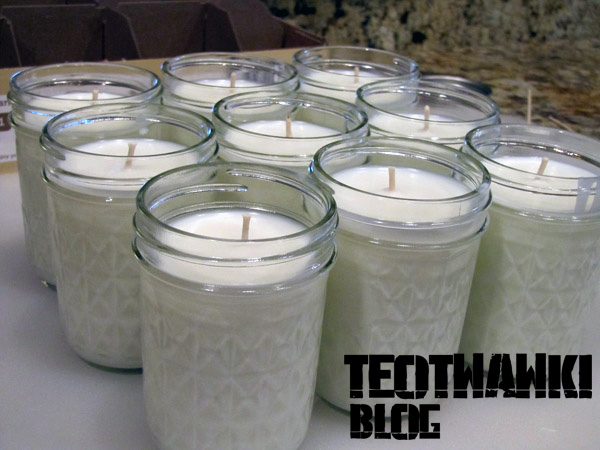
DIY Survival Candles


Candles are an easy-to-use source of emergency lighting and a little bit of heat. I'm shocked to see some of the prices that are charged for long burning candles sold for survival or emergency preparedness - if you want to buy a dozen or so candles, the cost really starts to add up.

Never fear! You can make your own survival candles at home for cheap, using high-quality, long burning soy wax. It's an easy project - the materials are easy to buy and you won't need any specialized tools.

10/11/11

Tip of the Day: Soda Bottle Skylight


Thanks to reader P.H. for passing this along. Innovative solution for bringing light into shacks and shanties.

EDIT: You can do a similar thing with a flashlight and a clear bottle full of water. Nalgenes work well. The water diffuses the light nicely. Improvised lantern of sorts.

8/10/11

Bacon Candle


Lighting is an important thing, and when the batteries run dry, you can improvise a simple candle or lamp with whatever fat, oil or grease you have around. This lamp was made with an extra tin, the fat/drippings from about 3/4 of a package of bacon, a wick made from half a cotton ball and a wick holder made from a twisted paper clip. That's it - pretty simple and easily improvised with what you have on hand.

People have been using candles and simple lamps for thousands of years, and they work, even in our modern age of LED flashlights. A fuel and a natural wick material (cotton works well and is readily available, but a variety of other materials work, too) are the consumables that you'll need - no grid or modern tech needed.

So far, this particular lamp has provided about 1.5 hours of light, completely uninterrupted. It doesn't kick off a massive amount of light, but definitely better than a tea light and enough to provide navigation light for a normal room. Simple tasks, sure. Reading...probably not so much, at least for my eyes. We're heading off to bed soon so I blew the candle out; I would guess it's got another hour and a half or so of life left in it, maybe more. I'll light it back up tomorrow.

A shot of the interior of the can, wick and holder after the jump below. For scale, the can is around the size of a tuna can - it held blueberries for a packaged muffin mix.

4/11/11

Flashlight fail

Had a power outage at work today. Nothing dangerous...just electricity out. It's still not resolved, so I am working from home this afternoon.

I have a Fenix AAA light on my keychain and carry a SureFire E1B usually, but was without the Surefire today. I have a flashlight that rides around in my EDC bag...a single AA light that I picked up from Target a few years back. A Rock River...haven't seen them anywhere else and will assume it's a cheap-o China light. It's been fine, no complaints, and was like $20. Anyways, power goes out, I find the bag and go to click the flashlight on. Nadda. After some fiddling, I was able to get it to turn on, but only for a few seconds before it died. Broken flashlight, dead battery. Not a good combo.

I have plenty of spare batteries in my EDC bag, but there was little point. It was only an inconvenient blackout, and my little Fenix light is probably brighter than the broken flashlight anyways.

Lessons Learned:

  • Redundancy is good - of my two flashlights, one worked.
  • Check batteries more often.
  • Don't buy cheap crap.
Anyways, replacement needed. I may use one of my other flashlights, but they're all bigger two-cell lights and I don't want to dedicate that much space to something I only use about once every six months. I like the size of the Surefire E1B, but don't want to pay that price again, especially for a rarely used backup item. May get a headlamp. Not certain at the moment.

12/27/10

Surefire E1B Backup, Final Verdict

I've had this light for about a month now, and since my initial review, I've only gotten to like this light more and more. What's to love:
  • Build Quality: It's a Surefire, so it's rugged and durable. I've accidentally dropped it onto a hard floor with no noticeable effects, and the light shows no additional wear after a month of carry. This light will last for years and years.
  • Variable brightness: The light's two brightness levels means you have the right amount of light on hand for the job. The normal level is perfect for when you need a lot of light and the low level is perfect for when you just need a little. The UI is simple and well thought out--it never gets in the way of running the light, and there's little hassle between changing modes. No secret twist twice, click five times combinations - just click once for the normal mode, click again for the low mode. The clickie button is great as well; easy to use, a good solid click, and has never come on accidentally.
  • Battery life: I'm not sure how long (minutes wise) I've used the light, but I use it daily for navigating around and during chores (especially with longer winter nights). I use it on both modes, but probably the normal/bright mode 60% of the time. It's still running strong on the first battery.
  • Size & pocket clip: As far as I'm concerned, the E1B has attained nirvana here. It's so comfortable and unnoticeable that I sleep with it tucked in my waistband every night. At the same time, it is not too small for fast and easy use, and would make a decent fistload in scuffle.
The cons against the E1B are mainly that it takes CR123A batteries and the price.

CR123As are pricey and hard to find locally at anywhere near reasonable prices (like $10 for a pair at big box stores). Online they're $1-$2 each, which is much more reasonable, but still quite expensive when compared to AAs. I'd wanted to switch over to lights that only ran on AAs for a while, but realized that I actually prefer the slightly wider/thicker and shorter CR123A lights. They just feel better in my hand. CR123As also put out more power, so a single-cell (one battery) CR123A light will be brighter than an equivalent single-cell AA light. And because the E1B is only using a single battery at a time, you'll eat through them at a slower pace than a typical two cell light. So personally, I don't mind that it runs on CR123As - it's actually a bit of a positive, but your mileage may vary.

Yes, for all of this awesome light, you have to pay a decent amount - $140 new. Quality usually has a cost to it. I won't go into any of the various adages about buying quality, but the E1B is a very, very good light and will last through many years or use. If you're fine with buying used, keep an eye out on the various internet sales boards and eBay. You should be able to find a gently used model for less. 

12/7/10

Review: Streamlight Nano Light

The Nano Light with a quarter and a Fenix LD01. The Nano Light is less
then 1.5 inches in length!
As I mentioned a bit ago, I'm building up an Altoids Survival Tin for a gift exchange that I'm involved in. I've pulled together most of the pieces that I had lying around and ordered up the rest.

I consider some kind of flashlight to be a fairly essential item in a survival kit, even in a pocket sized kit. Something small and inexpensive (around $5), but rugged and bright. The Streamlight Nano Light matched those specifications. It's bite sized, as you can see from the pictures, and I've had good luck with Streamlight lights in the past. The kicker was the price, only $5.99 from Amazon.

I've had all of the various Photon lights and eventually settled on Fenix AAA-sized lights for my own keychain/EDC use. The AAA-sized lights are small, but the Nano is minuscule in comparison, and the brightness is similar to the Fenix E01--10 lumens, though side-by-side, the Nano looks brighter, which is shocking.

The Nano Light looks tiny even next to a Photon!
It turns on/off with a twist, which I much prefer to the squeeze lights, which I find turn on accidentally too easily. The Nano Light is well and sturdy--it claims to be "weather proof," though I'm not sure what exactly that means.

One downside of the Nano Light is that replacement batteries cost about as much as a new light. Unlike the Photon lights, though, they are very easy to replace.

Overall, the Nano Light is a great choice when you need a cheap, rugged and ultra-small light. It's the best option that I've seen for pocket survival kit light, and also a good choice if you're looking to cut down on key chain bulk. At $5.99, they're hard to beat.

Get the Streamlight Nano Light >

12/2/10

Surefire E1B, EDC Flashlight - Initial Review

I am not the flashlight junky that some are. I have a few lights, but my go-to lights are a Fenix AAA keychain light and a Night Ops Falcata. The Fenix is great because it rides on my keys, unnoticed until it's needed. I recently upgraded to an LD01, which provides a decent amount of light on turbo mode, especially for such a small light. The Falcata is my nightstand light - more powerful than the LD01, with a great "clickie" tail cap. It's a bit too big to carry around easily most of the time, and the older xenon bulb is getting outdated.

I recently picked up a Surefire E1B to act as an intermediate light - somewhere between the LD01 keychain light and the Falcata on my night stand. I knew all about Surefire's stellar reputation, but haven't joined the owner's club. The E1B has gotten great reviews all over, so I took the plunge.

I've had the light for about 24 hours so far, and have to admit, it's about perfect. Build quality is rugged and well-crafted. Overall, it's a very compact light, while still maintaining an easy-to-hold size. The light is plenty bright, with awesome throw and plenty of useful throw - it blows my Falcata away completely. We're talking about lighting up objects a hundred yards away. The clickie tailcap is the best that I've handled, and the UI is simple and straightforward. The low mode still provides plenty of useful light for most tasks. I think my favorite part of the light, though, is the pocket clip. Sturdy, low-riding and with just-the-right-amount of tension. This is how to do a pocket clip! I generally carry my lights on my front, left-size IWB (about 11 o'clock), and the E1B disappears in this position...I don't notice it's there until needed, which is the point!

Again, I've only had it for a day now, and I'll be giving it a more thorough workout as it gets added into my daily carry. I'll keep you posted if my feeling about the E1B change, but so far, I'm thrilled. Big thumbs-up for EDC  use!

2/11/08

Survival Lighting, pt. 2

Alright, so headlamps are king for all-around use. Hands free, long battery life, all that good stuff. But, hey, they SUCK for tactical use. Yep, not exactly the best idea to run around a firefight with a big light on top of your head. No good for momentary lighting--flashing an area quickly. And nowhere near the brightness of today's tactical flashlights--we want retina-melting lumen count here.

Here's where your second light comes in, the high-intensity, hard-use tactical light. Typically they run on CR123a's, and typically blast out close to a hundred (or more) lumens, and have a "clickie" tail cap for momentary on. They're blindingly bright; all the light you'll need in a tough situation. They're specifically designed for combat and abuse, hardened to survive impact, and reinforced to handle the recoil of a firearm.

Surefire is the big name in the tactical flashlight market, and they have a bunch of solid products. They've recently begun an update of their line, switching over from xenon bulbs, which can burn out and break, to high-output LEDs, which will last for 100k+ hours of use, and also have a better run time. If you're in the market for a new flashlight, make sure it's an LED light...the xenon bulbs are quickly being phased out in favor of new, better LED technology. Worrying about bulbs burning out, needing to carry replacement bulbs...ya, lame. LED's all the way.

While Surefire is the top name, they've got a number of competitors who are nipping at their heals, and often times, releasing cooler, more cutting-edge lights. Fenix is the name that first comes to mind. I have a little AAA light, and E1, that has been great. Fenix has some very impressive offerings, and they're usually about half the price of Surefire's. They're made in China, but in my experience have been very solid quality. There are, of course, dozens of other manufacturers of lights. The Candle Power Forums offers more information than I could ever hope to cover.

An issue with most "tactical" lights is that they run off CR123a's, which are easy to find on the Internet, but harder to find locally, and run $1-$4 a pop, depending on where you get them. They have a shelf life of 10 years, so buy in bulk, online, for the best deal. Most of your other gear will probably NOT run on CR123a's, meaning you'll have to stock up on at least 2 different kinds of batteries. There are a few good lights on the market that run on AAs. I'm looking at the Nightcore Defender Infinity, but there have been troubles with the manufacturer getting these out to market. A cool light though, by the look of it.

The most easily available lights would probably be the Surefire G2 LED and the 6P LED, which are both sold at Lowe's hardware, amongst other places. Both are good quality lights. I've heard some very good things about the Brinkman lights sold at Wal-Mart, I believe, but I have no experience with these lights.

If the headlamp is your all-around, utilitarian light, the tactical flashlight is your panic light. This is your emergency light, the light you turn to when you NEED a handheld spotlight, right away. Keep it close and quickly accessible, ready for use.

Here are some great videos on YouTube covering Low Light tactics, from the Surefire Institute:

Low Light Technic 1


Low Light Technic 2


Low Light Technic 3


Enjoy the background music!

9/18/07

Stealth Preps: Ikea Tealights

Popped into the massive, endless beast of a store that is Ikea to buy some furnishings for our new place today...ended up coming across their bulk packs of tealights. 100 tealights for $2.99. They don't give off a ton of light, but one gives enough light to help you navigate a dark room safely. Multiple tealights are even better! They burn for a few hours--I'm expecting 2-3.

They also sell a little "lantern" to put the tealights in; $3.99 I think it was. Not the sturdiest affair, but it does a fairly good job of protecting the candle. Kind of fun and stylish. Has a wire you could hang the lantern from, or hold onto if you were carrying it around.

Here's a crappy picture that I took of a tealight and the lantern in action:


The tealights may not exactly be blinding, but they give off a similar amount of light to the "30/50/100 hour survival candles" out there on the market that run around $6/per. At $2.99 for 100, you can have 200 tealights for the price of 1 survival candle--a dang good buy if you ask me.

I've poked around briefly online, and Ikea's price is hard to beat. Websites are selling them for $15/100! You can get 500 Ikea tealights at that price! If you're stocking up on candles and lighting, or if your wife drags you to Ikea, you might want to check them out!